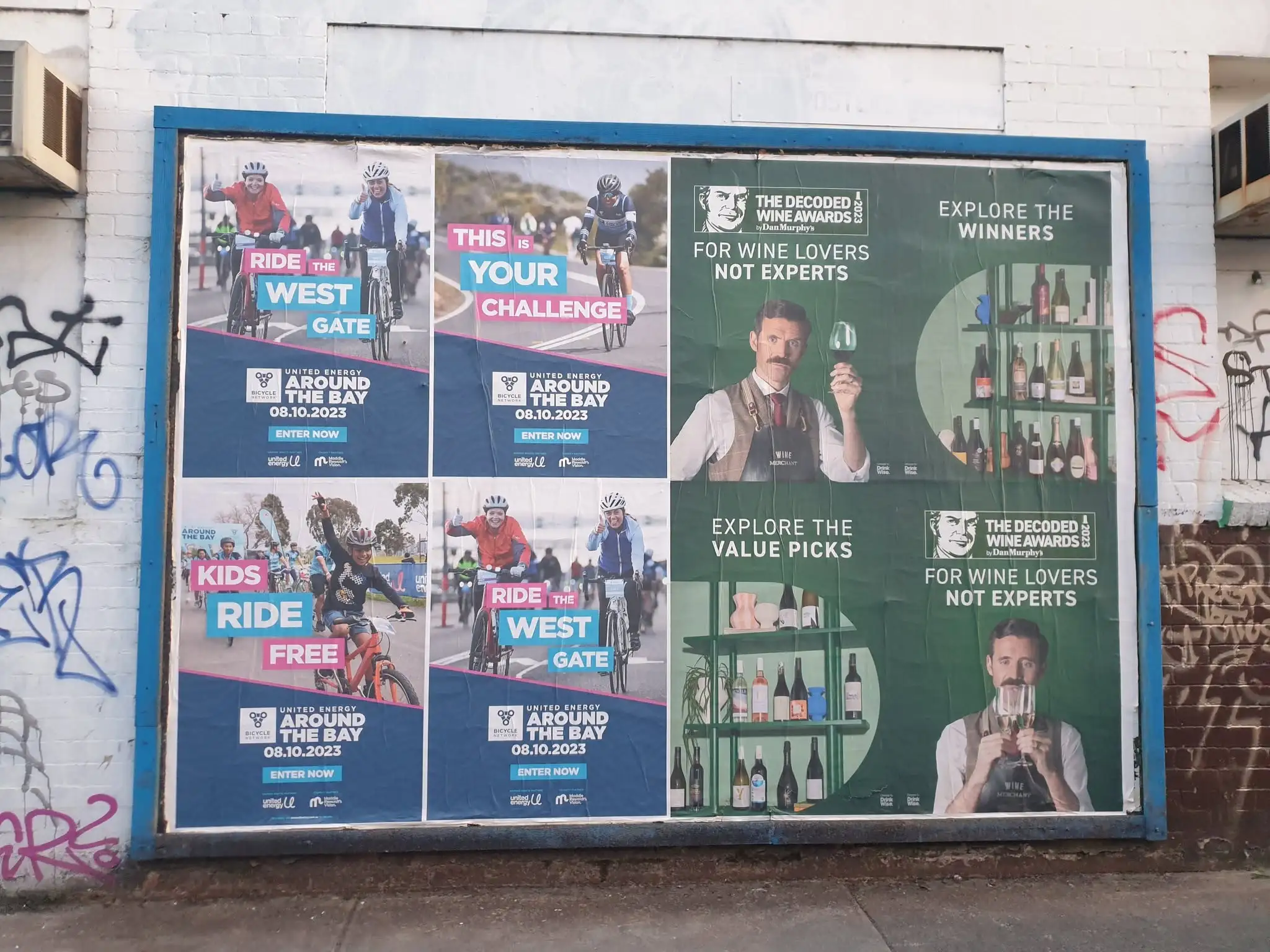
A successful community poster campaign in Australia starts with a clear objective, a defined audience and a practical plan. You don’t need city-wide coverage to get seen with a street poster campaign.
You need the right message in front of the right people, often enough to get noticed. That’s where a bit of street smarts helps. For a local cause, a focused run can create more useful visibility than scattering posters across a wider area.
And street-level OOH is far from a fading format. Australia’s out-of-home (OOH) industry generated $1.45 billion in net media revenue in 2025, up 11.43% year on year, according to the Outdoor Media Association (OMA) for 2025.
The trick is to make each decision work towards the same outcome: getting your community to notice, engage and act.
1. Start With The Objective
Start with the outcome, not the poster count. What do you need people to do after they see the campaign? That decision will shape where you place the posters, how long you run them and what the creative needs to say.
For community and grassroots campaigns, four objectives come up regularly:
- Event turnout: Drive attendance at a local event.
- Cause awareness: Build recognition around an issue.
- Sign-ups, petition signatures or council submissions: Encourage people to take a specific action.
- Volunteer recruitment: Get more people involved.
The same medium can support all four, but the campaign decisions will look different.
An event poster needs the date, location and reason to attend front and centre. A volunteer campaign needs to make participation worthwhile and give people a clear next step. A petition or community submission needs to make the action simple and obvious.
Once you know what success looks like, you can build your poster campaign planning around it.
2. Sizing The Campaign and Setting a Budget
There’s no single price for a community poster campaign. What you spend depends on how you structure the run.
The main cost drivers are:
- Number of poster sites
- Size of the print run
- Campaign duration
- Print specifications
Design, distribution and installation requirements can also affect the total.
The better approach is to start with the audience and work backwards. Identify the areas that matter, decide how much visibility you need and then determine how many sites your budget can support.
Bigger isn’t automatically better. A smaller, concentrated run can create stronger relevance and frequency than a larger campaign spread thinly across a city.
That principle applies across the wider OOH market too. Australia’s OOH industry recorded $744.1 million in net media revenue in H1 2026, up 6.51% year on year, according to the OMA for H1 2026.
For a community campaign, though, market size isn’t the point. You’re not trying to buy as much space as possible. You’re trying to put the message where it has the best chance of changing behaviour.
Street posters can also sit alongside other channels in a wider marketing mix. The useful question isn’t whether posters should replace every other channel. It’s where physical visibility can strengthen the campaign and reach people in the real-world environments that matter to your cause.
Start with one question: Where do we most need to be seen?
3. Choosing Your Locations
The busiest street isn’t automatically the right street.
Foot traffic matters, but audience relevance matters just as much. A high-traffic CBD location may deliver plenty of movement while doing little for a campaign focused on one neighbourhood or local issue.
Think about where your audience already spends time. That’s where you’re more likely to get genuine cut-through.
For a community campaign, that might mean:
- Near the event venue
- Around the affected area
- Close to community hubs
- Along regular local routes
Clustering sites can be particularly useful. Rather than placing a handful of posters across an entire city, concentrate them within a suburb or defined precinct, so the same people have more opportunities to encounter your message.
That repeated presence can give a grassroots poster campaign more cut-through than a scattered run.
Say you’re promoting a neighbourhood fundraiser. Sites around the venue and nearby community hubs may be more valuable than isolated placements several kilometres away. The campaign has a clear centre of gravity, and the people most likely to attend keep seeing it.
Rock Posters’ network supports strategic street-level placement across relevant neighbourhoods, helping you build a run around your audience and objectives rather than simply buying available space.
4. Timing and Run Length
Starting too late is one of the most common mistakes in grassroots campaigns.
Getting posters onto the street involves more than approving the artwork. Design, print and site booking all need time before installation, so build those steps into your schedule from the beginning.
For an event, work backwards from the date that matters. That gives you a practical deadline for the creative, production and booking stages before anything goes up.
Leave it until the final few days and your options narrow. You may have less choice around sites, less time to refine the creative and less opportunity to build visibility before people need to act.
Run length should follow the objective.
An event campaign may need concentrated visibility in the lead-up to a fixed date. A general awareness campaign may benefit from staying in the environment for longer.
We identify two to four weeks as a typical street poster campaign duration. Longer runs can also be arranged when the campaign calls for additional visibility.
Posting cycles can affect the number of posters required during a longer campaign, particularly where posters need to be rotated or refreshed.
The practical lesson is simply to plan around when your audience needs to act.
5. Design and Applications
A street poster needs to work quickly. Give the main message room to breathe, make the hierarchy obvious and make the next step easy to understand. If you’re using a URL or QR code, it should be easy to find without competing with the headline.
For more practical guidance, see What Makes A Good Poster Design?
The application matters too. Wheat pasting uses adhesive to apply posters and create a paste-up on the selected surface, with preparation and installation helping the finished work look clean and stay visible. Rock Posters manages distribution and installation through its Australia-wide network, taking another operational job off the campaign coordinator’s list.
For more detail, see Everything You Wanted To Know About Wheat Pasting
6. Measuring The Campaign
A campaign shouldn’t end when the posters go up. Decide what success looks like before the first poster is installed.
The measurement method should follow the objective. An event campaign could track registrations or ticket sales. An awareness campaign might look at website traffic, branded searches or social engagement. A petition or submission campaign could use a dedicated landing page to track responses.
Where possible, give the campaign its own response mechanism. A trackable URL, QR code, landing page or campaign-specific hashtag can make it easier to connect street visibility with action.
It’s also worth establishing a baseline before launch. Compare campaign-period activity against that baseline rather than relying on a single metric after the posters come down.
If you’re running multiple sites, look at the locations individually too. Stronger engagement in one suburb can tell you something useful about where your audience is responding.
Measure before you launch, not after. See How To Measure The Impact Of Street Poster Campaigns for more practical guidance.
Plan Your Next Campaign With Rock Posters
A strong community poster campaign doesn’t require blanket coverage. It needs a clear objective, relevant locations and enough time to build visibility.
Think about the campaign as one connected plan. Start with who you need to reach and where they spend time. Then decide when they need to see your message and what you want them to do next.
That approach keeps the focus on the outcome rather than the number of posters. It also gives a constrained budget a clearer job to do.
Rock Posters is independently Australian-owned and has operated since 1986. We have in-house production in Melbourne and Sydney, supported by an Australia-wide network.
Whether you’re promoting an event, building awareness, encouraging submissions or recruiting volunteers, our team can help you work through the practical details and shape a run around your campaign goals and budget.
Ready to put your campaign on the street? Speak with the Rock Posters team about your objective, audience and target areas.
We’ll help you work through the practical details and build a campaign that makes sense for both your audience and your budget.
Frequently Asked Questions
How Do You Run A Community Poster Campaign In Australia?
To run a community poster campaign in Australia, start with your objective and audience, then choose your locations, set a budget, prepare the creative and schedule the run. Working backwards from the action you want people to take helps you make smarter calls on placement, timing and how often your audience sees the message.
How Much Does A Community Poster Campaign Cost?
The cost of a community poster campaign depends on the number of sites, print run, campaign duration and poster specifications. Design, distribution and installation can also affect the total. If you’re working with a tight budget, putting your spend into fewer, more relevant locations can help you get better cut-through.
Where Should You Place Posters For A Community Campaign?
Place posters where your target audience already spends time, rather than simply chasing the busiest streets. Think near event venues, affected neighbourhoods, community hubs and regular local routes. Clustering sites within a defined area can also build frequency, giving the same audience more chances to notice your message and take action.
How Long Should A Community Poster Campaign Run?
A community poster campaign typically runs for two to four weeks, depending on your objective and timing. A fixed-date event may need concentrated visibility in the lead-up, while an awareness campaign may benefit from a longer run. Plan ahead for design, print, site booking and installation so you’re not rushing the job.
What Should A Community Campaign Poster Include?
A community campaign poster should lead with one clear message, an easy-to-read headline and an obvious next step. Include the details people need, such as an event date or location, without cramming everything onto the page. If you’re using a URL or QR code, make it easy to spot and use.
Author: Paul D. Frehley
Rock Writer (Paul D. Frehley) is the editorial voice of Rock Posters, Australia’s independent out-of-home media network with printing facilities in Sydney and Melbourne. Since 1986, we’ve helped brands, events, and cultural institutions — including the National Gallery of Victoria, the Sydney Film Festival, and the Australian Museum — show up where their audiences already are. We cover campaign strategy, creative execution, and the thinking behind effective street-level and large-format advertising. As an award-winning sustainability leader, we’re also committed to making outdoor advertising better for the communities and environments where we work.