Key Insights
- Rock Posters still runs street posters through a refurbished SIAS automatic clamshell press, in-house in Thornbury, Melbourne
- Screen printing handles fluro colours, heavier ink coverage and stock digital can’t match
- The press can safely print up to 1500mm × 1000mm, on stock from 100gsm MG litho to 5mm corflute
- A two-colour poster needs two full colour passes, and more colours mean more screens, more prep and more cost
- Digital is faster and more cost-efficient at volume; screen printing earns its place when the creative calls for fluro or distinctive finish
- Rock Posters has screen printed since 1986, and still runs the press today for clients like RMIT
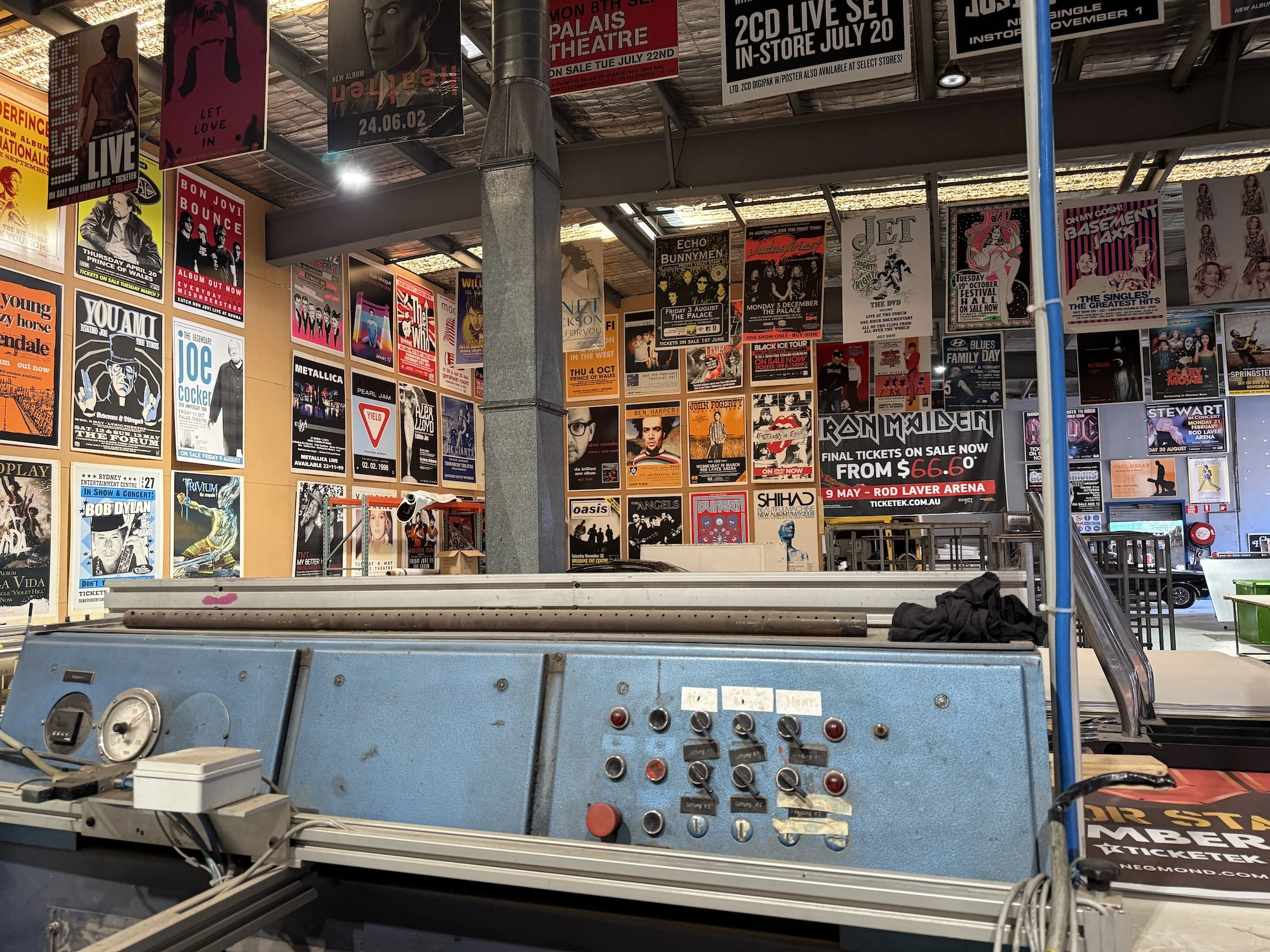
At Rock Posters, the screen-printing process still runs through a refurbished SIAS automatic clamshell press in our Melbourne production facility. Despite its old-school, heavily manual process, our screen-printing press still supports the production of high-quality street poster campaigns for brands and organisations Australia-wide.
Screen printing remains useful when the creative calls for heavier ink coverage, fluro colour or a particular printed character that digital can’t replicate.
It is also running in a market that’s far from standing still. Out-of-home (OOH) advertising net media revenue grew 5.58% in Q2 2026 to reach $385 million, according to the Outdoor Media Association. Street posters are a small but distinctive part of that growth, and screen printing helps keep them standing out. In this article, we interviewed Luke Stewart, Artwork & Production Manager at our Thornbury workshop, for more details on the machine he knows inside and out.
The Press
The press is a refurbished machine believed to date from around 2000
Rock Posters has used several presses over the years, including Eclipse and Simplex machines. They’ve all shared the same basic clamshell design. A clamshell press works like a hinged lid. The screen lifts away from the print surface, allowing the stock to sit underneath before printing.
Our press can safely handle prints up to 1500mm × 1000mm. That gives us plenty of flexibility across different poster sizes and materials.
It can print on 100gsm MG litho for street posters, fine art stock up to 310gsm and 5mm-thick corflute for election work. You can also review our poster specifications when planning artwork and production requirements.
How A Screen Printed Poster Is Actually Made
Screen printing takes more preparation than digital printing. How the artwork is designed can also affect the production process, particularly when you consider colour count and poster impact.
1. Coat The Screens
Before processing the artwork, we coat the screens with emulsion. This happens in the dark room, where the screens are then left to dry before exposure.
2. Separate The Colours
When the artwork arrives, we first determine how many colours it contains. For a two-colour poster, the artwork goes into Photoshop and each colour is separated for production.
3. Make The Positives
Each colour separation is printed onto plastic film. This film is called a positive and carries the artwork that will be transferred onto the coated screen.
4. Expose The Screen
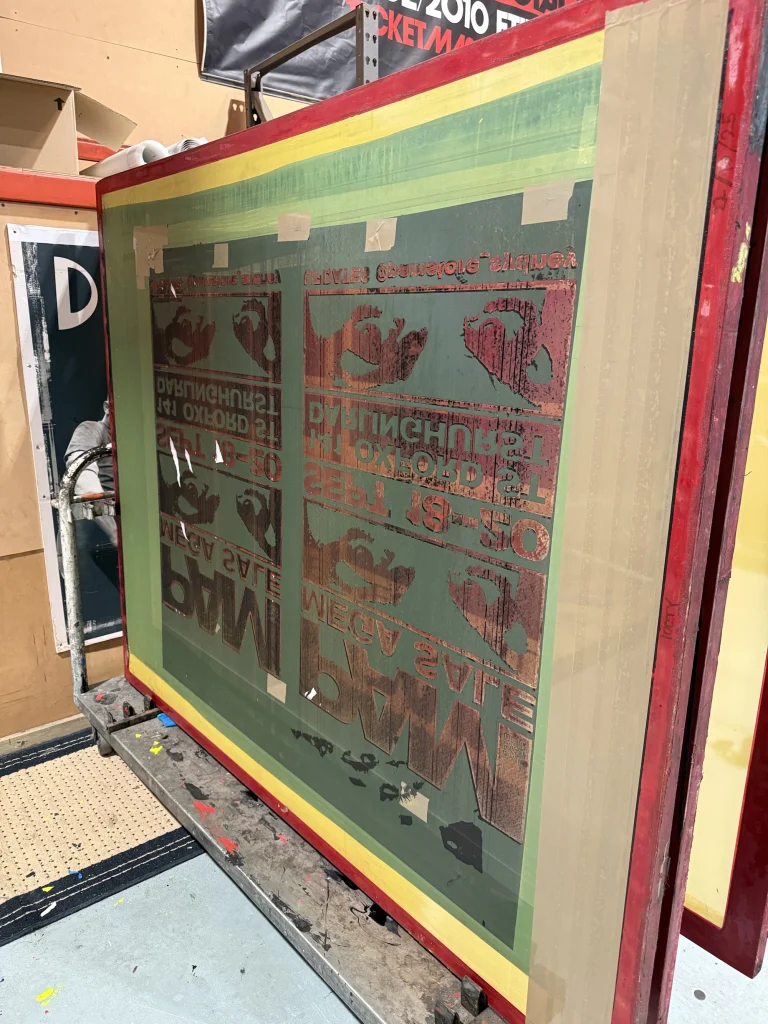
The positive is taped to the coated screen, which then goes into a glass frame for exposure. A vacuum removes the air between them, holding both surfaces tightly together before the screen goes under a UV lamp.
That vacuum matters because it keeps the positive and screen dead flat. Close contact helps preserve fine detail during exposure, allowing the artwork to transfer accurately onto the screen.
5. Wash Out
After exposure, we remove the positive and take the screen to the wash bay. It’s blasted with a gurney and, if everything has worked correctly, the image appears.
The screen then goes into a heat cupboard to dry. Once it’s ready, it can move onto the press.
6. Print
We block out the screen edges before mounting it onto the press. Then we line it up against the registration sheet, lock it into position and fit the squeegee and flood bar.
The first colour can then be printed. Getting the registration right matters because every subsequent colour needs to land in exactly the right place.
7. Repeat For Every Colour
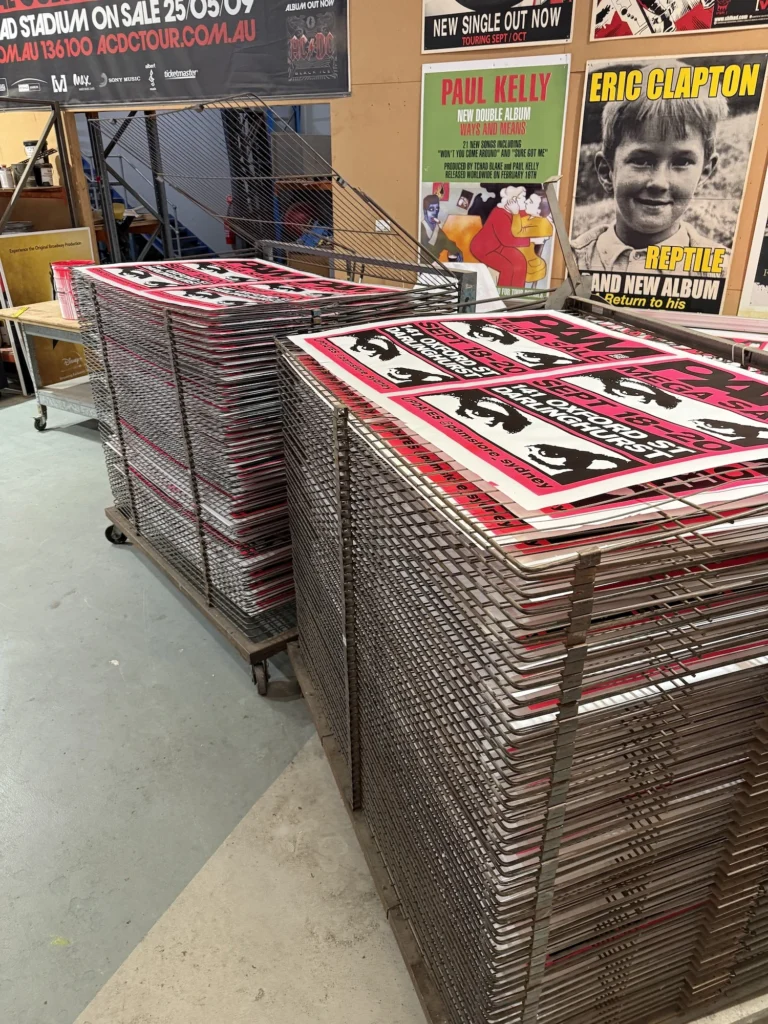
Once the first colour is dry enough, the next screen is prepared, and the process starts again. A two-colour poster therefore needs two separate colour passes.
This preparation is what makes screen printing more labour-intensive than digital. Once preparation is complete, a run of 100 two-colour posters at 1400mm × 1000mm can take a few hours.
Back when screen printing was all we did, someone could spend most of the day making positives and coating screens. That preparation kept jobs moving through the press.
The 10,000-Poster Fluro Nightmare
Reflecting on what’s been produced at Rock Posters, the biggest job Luke has personally printed was an order for 10,000 Club Retro pole posters for Sydney. It was a two-colour poster, with the first colour created from a three-colour fluro blend.
The challenge was controlling three inks on the same screen. The inks needed to mix where the colours touched, but not so much that they blended together and turned brown.
That’s manageable across 100 posters. Repeat it across 10,000, and consistency becomes the real challenge.
The job shows why production scale matters. A technique that works beautifully on a smaller run still needs to perform thousands of times consistently.
What Screen Printing Does That Digital Can’t
Screen printing has some clear advantages when the campaign needs them. Digital printing has its own strengths, particularly when speed, flexibility and cost efficiency matter more.
| Consideration | Screen Printing | Digital Printing |
| Colour | Strong spot and fluro colours | Broad digital colour reproduction |
| Ink coverage | Thicker ink coverage | Thinner ink application |
| Production | More preparation per colour | Faster setup and changeover |
| Creative approach | Works well with limited colour palettes | Greater flexibility for variable artwork |
| Best suited to | Fluro, bold colour and distinctive finishes | Speed, flexibility and larger variable campaigns |
| Cost consideration | More colours mean more screens and preparation | Generally more cost-efficient at volume |
Fluro is the obvious example. Standard CMYK printing has a limited colour gamut, while Pantone identifies spot colours as a way to produce colours outside ordinary process printing.
There’s also a creative advantage to working within limits. Every additional colour means another screen, more prep, and higher production costs.
That pushes designers to get more from two or three colours. If you’re planning artwork around a limited palette, our design tips page has practical guidance for making it work.
But screen printing isn’t automatically the better option. Digital is faster, more flexible and often more cost-effective for larger or variable campaigns.
The right choice depends on what the creative needs to achieve. If you need fluro, heavier ink coverage or a distinctive screen-printed finish, that’s when the process earns its place.
How To Spot A Screen Printed Poster In The Wild
You can often spot a screen-printed poster without knowing anything about the production process. Start with the colour, particularly if the design uses a tight palette with strong, punchy solids.
Then look closer at the print itself. Small imperfections such as flap-ups or ink smears can appear during production.
Luke sees those details differently. They give the poster personality.
The design itself can also be a clue. When every additional colour requires another screen, designers often find clever ways to make a limited palette work harder.
1986 To Now
Rock Posters has been screen printing since 1986. Digital printing didn’t exist then, so posters were produced on hand-squeegeed presses, with much of the artwork hand-drawn and hand-cut.
The industry looks very different today. Old-school hand-drawn and hand-cut street posters are now rarely produced, while hand-cut stencils are mostly reserved for personal art projects.
The darkroom process for making positives has changed too. Rock Posters once relied on another business to process film, before that process was replaced by an Epson printer in the early 2000s.
Some processes have stayed, though. Rock Posters still uses screen printing, offset printing and the darkroom for unique campaigns every so often.
The press therefore remains part of a business that has adapted its production methods alongside the changing poster industry, as covered in our story about Rock Posters.
What Comes Through The Press Now
Today, screen printing is mainly used when artwork needs fluro colour. It’s also used when clients specifically request screen-printed street posters.
RMIT has its art show street posters screen printed most years. Ben Brown has also been a staple of Australian and international street poster art.
We use it when the process adds something to the finished campaign and the budget allows. For marketers, that makes screen printing another production option to consider alongside digital.
Why We Still Do It
For our very own Luke, screen printing started with music. He grew up around punk rock and heavy metal, surrounded by photocopied flyers, hand-drawn artwork and old-school gig posters. As a kid, he and his friends visited a record store called Flex Your Head. They couldn’t afford much, but they could browse the records and flip through the US gig posters. That connection between music, artwork and physical print eventually became part of his working life. You can still see that history throughout the Rock Posters factory.
Each member of our team has a unique background that drives their passion for art, music, and street posters, but Luke in particular is most deeply passionate about our remaining analogue printing processes.
At Open House Melbourne 2026 in July, thousands of visitors came to our Thornbury facility and were especially drawn to the posters covering the walls (our poster museum) as well as Luke’s analogue printing tour. Visitors were particularly surprised by how different those production methods are from standard printing in 2026, and how increasingly rare they are becoming.
Although screen printing has been part of Rock Posters’ history for decades, our team remains passionate about our press’s ability to deliver unique, high-quality, impactful artwork for campaigns.
Plan Your Next Campaign With Rock Posters
Choosing between digital and screen printing starts with your campaign requirements. If speed and cost efficiency matter most, digital may be the better fit. And if your creative needs fluro colour, heavier ink coverage or a distinctive screen-printed finish, screen printing may deliver more cut-through.
At Rock Posters, we can help you weigh those trade-offs. We’ll consider your artwork, stock, run size and campaign requirements before recommending the approach that makes sense.
Speak to our team about your next street-poster campaign. We’ll help you work out which production method is right for the job.ur next run. If you are shaping your next out-of-home campaign, static street posters deserve a place on the plan. Discuss your upcoming campaign with our team today.

Author: Paul D. Frehley
Rock Writer (Paul D. Frehley) is the editorial voice of Rock Posters, Australia’s independent out-of-home media network with printing facilities in Sydney and Melbourne. Since 1986, we’ve helped brands, events, and cultural institutions — including the National Gallery of Victoria, the Sydney Film Festival, and the Australian Museum — show up where their audiences already are. We cover campaign strategy, creative execution, and the thinking behind effective street-level and large-format advertising. As an award-winning sustainability leader, we’re also committed to making outdoor advertising better for the communities and environments where we work.