Key insights
- Audiences have become expert at avoiding advertising, with close to a third of internet users running ad blockers and around 85 per cent of online ads failing to clear the 2.5-second mark that researchers link to memory.
- AI-generated content is filling the feed and eroding trust, and when shoppers notice AI in a brand’s own marketing they are about four times more likely to trust the brand less than more.
- Out of home is unskippable, unblockable and always-on, it reaches people in the real world where trust still holds, and it is the fastest-growing major medium in Australia at $1.44 billion in 2025.
- High-frequency presence in the right precincts builds mental availability, so a brand comes to mind at the moment of choice.
- Put the street back at the centre as the reinforcement layer that makes the rest of your mix work harder, with creative built for the medium.
Think about the last digital ad you watched all the way to the end. Most of us skip the pre-roll the moment the counter allows it, scroll past the feed unit without registering it, and run a blocker that clears the rest before it loads. Audiences have become very good at protecting their attention.
In 2026, a new pressure has landed on top of that: a wave of AI-generated content that people are quickly learning to distrust at first glance.
With this in mind, we can recognise that the channel that still cuts through is the oldest and most physical one. The street is unskippable, unblockable and unmissable; it lives in the real world where trust still holds, and it belongs back at the centre of the plan as the layer that makes everything else work harder.
Audiences Have Learned To Skip, Block And Scroll Past
Close to a third of internet users now run an ad blocker at least some of the time, according to GWI’s numbers, and the habit is led by 18- to 34-year-olds, who are the ones most brands are trying hardest to reach. The ads that do get through face a steeper test again.
Amplified Intelligence puts the share of online ads that fail to clear the 2.5-second mark, the point researchers link to a brand forming a memory, at around 85 per cent. Read it the other way around, and most digital impressions are paid for and then forgotten in a blink.
This is not a claim that digital advertising stopped working. It is a reminder that attention has become a scarce resource, and that winning it is getting more expensive. Dentsu’s work on the attention economy found that a 5 per cent lift in attention can drive close to a 40 per cent rise in awareness, which shows how much rides on being seen properly rather than simply being served. The brands pulling ahead are the ones buying attention, not just impressions.
AI is The New Pressure On Trust
Generative tools have filled the feed with synthetic images, voices and articles, and people have noticed. Jumio found that roughly seven in ten consumers are more sceptical of what they see online than they were a year earlier, specifically because of AI-generated fraud, and Deloitte’s research points the same way. For marketers, the signal is sharper still. When shoppers spot AI in a brand’s own marketing, research from Klaviyo and Datalily, surveying 8,000 people, including Australians, found they are about four times more likely to trust the brand less than more.
This is where a physical medium quietly earns its keep. A poster on a wall is made by people, printed on paper, and pasted in a real place you can walk past and touch. It carries none of the “is this even real” hesitation that now shadows a slick digital execution. In a year when authenticity is harder to prove on a screen, the street reads as exactly what it is.
Why The Street Keeps Working When Other Channels Fade
Outdoor and street posters in particular have three qualities that hold up no matter what the feed is doing:
- They are unskippable and unblockable, so there is no counter to wait out and no extension to install.
- They are always-on, working on the people who pass them every day.
- They reach those people in real life, at scale, where they already are.
The market is voting accordingly. The Outdoor Media Association reported that out-of-home reached $1.44 billion in Australia in 2025, up more than 11 per cent on the year, making it the fastest-growing major medium, and its chief executive described outdoor as delivering the strongest return on investment of the major channels.
Additionally, The Harris Poll found that 79 per cent of people named in-person, real-world experiences as their most memorable, well ahead of anything they met on a screen. Frequency in the right places, day after day, is how a brand builds mental availability, the quality of coming to mind easily at the moment someone is choosing. The street is built to deliver exactly that.
The Channel That Has Outlasted Every Disruption
Posters were on walls long before the first banner ad, and they have watched a parade of digital formats arrive, peak and fade.
For Rock Posters, we have been on the street since 1986, and in that time, the medium has only grown more valuable as the channels around it have grown noisier. When a platform rewrites its algorithm overnight, or a format collapses under its own clutter, the wall is still there, doing the same honest job it has always done.
For Australian brands, relying on a single digital marketing effort can make them overly dependent on digital platforms and vulnerable to the consequences of change. For example, Dashdot announced last month, May 2026, their voluntary liquidation, citing three core forces that led to their farewell. One significant change to Meta’s advertising platform is causing major disruptions to the audience-targeting methods they’d relied on to drive inbound leads for years. Their cost to acquire clients more than doubled and was completely unsustainable moving forward.
Street posters and billboards, on the other hand, don’t rewrite overnight. And when paired well with digital marketing strategies, they can amplify their impact on audiences, reduce cost per acquisition, build trust, and drive sustainable sales.
How To Use It Well In 2026
None of this is an argument against digital. Digital does things the street cannot, and the smartest plans use both. The question is where the street sits in the mix. Treat it as the reinforcement layer, the always-on presence that gives your digital and social work something solid to stand on, lifts recall, and turns a campaign into something people feel surrounded by rather than served.
A few things make it pay:
- Brief the creative for the medium: human-crafted, simple and bold, made to be read at a glance, since this is one place where the human touch is now a measurable advantage.
- Use precinct and proximity targeting to concentrate your frequency in the suburbs and around the locations where your audience actually moves.
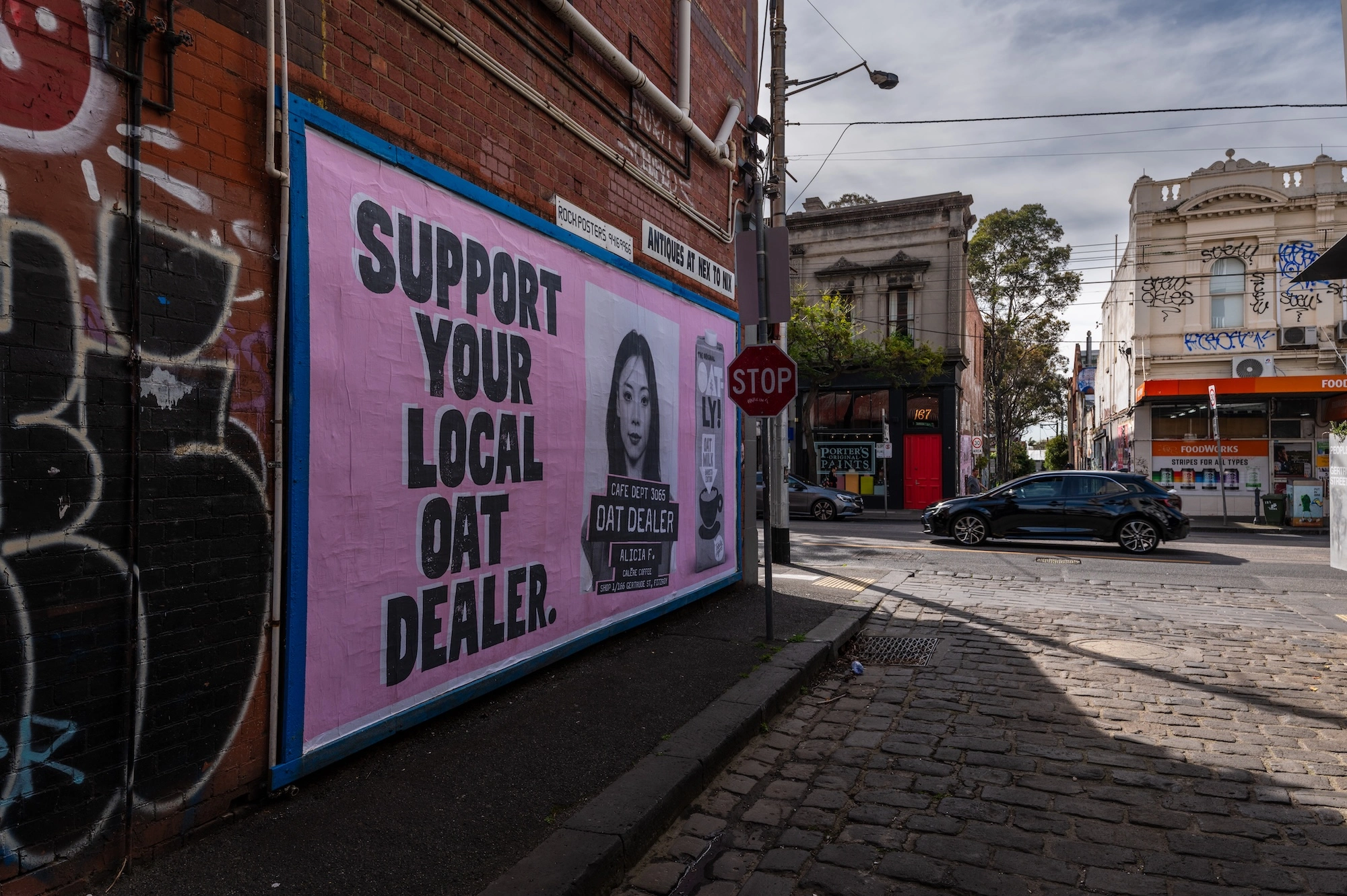
- Give the work a reason to be talked about. We saw all of this come together in a campaign that turned the street into a conversation and drove a 700 per cent lift in demand for a brand starting from almost nothing: https://www.rockposters.com.au/how-oatly-turned-the-street-into-a-conversation/
Build Something Unmissable
If your 2026 plan rests entirely on channels people have learned to skip, block and scroll past, it is worth asking what is carrying the weight in the real world.
Talk to the Rock Posters team about putting the street to work alongside the rest of your mix.

Author: Paul D. Frehley
Rock Writer (Paul D. Frehley) is the editorial voice of Rock Posters, Australia’s independent out-of-home media network with printing facilities in Sydney and Melbourne. Since 1986, we’ve helped brands, events, and cultural institutions — including the National Gallery of Victoria, the Sydney Film Festival, and the Australian Museum — show up where their audiences already are. We cover campaign strategy, creative execution, and the thinking behind effective street-level and large-format advertising. As an award-winning sustainability leader, we’re also committed to making outdoor advertising better for the communities and environments where we work.