Key insights
- The challenge: OATLY launched into a brand-new category, oat milk in coffee, with low awareness and almost no consideration, so it had to build the category and the demand at the same time.
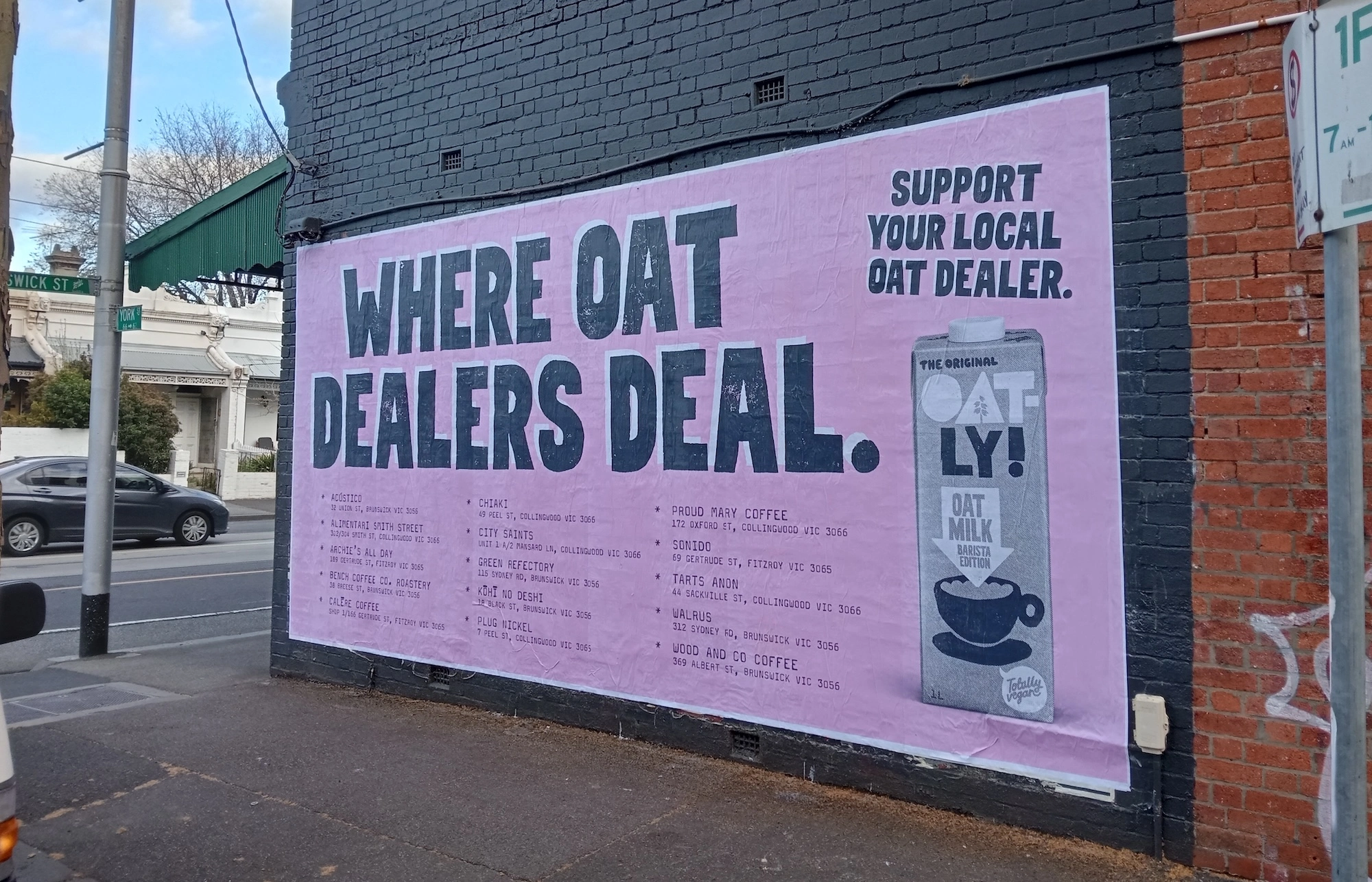
- The move: the campaign treated inner-city coffee culture as the battleground, dominating precincts across Melbourne and Sydney with hyper-local street posters and sequential, self-aware creative that turned the street into a conversation.
- The result: more than 13 million earned impressions, over 10,000 coffee redemptions, and a 700 per cent lift in demand at a 21 per cent compound annual growth rate.
- Why it worked: high-frequency presence in the right precincts built mental availability, so the brand came to mind at the moment a coffee decision was made.
- For your next launch: street posters earn their place on any launch, new-category or challenger brief, as long as the creative is built for the medium.
OATLY arrived in Australia with a product most people had never heard of, in a category that barely existed. Oat milk as the barista’s choice was a new idea, awareness was low, and consideration sat close to zero. The campaign that changed that did its heaviest lifting on the street.
Across the inner suburbs of Melbourne and Sydney, a run of street posters built frequency, started a conversation, and helped drive a 700% increase in demand. Here is how it worked and what it offers any brand-side marketer with a hard launch ahead.
The Challenge: A New Category Nobody Was Asking For
OATLY faced the hardest version of a launch problem. Awareness was low, the category itself was new, and consideration was negligible. People were not weighing OATLY against the alternatives, because most had no reason to think about it at all.
When a brand has to build the category and the demand at the same time, the usual performance playbook strains, since there is very little existing intent to capture. The real job was to build mental availability from a standing start, so the brand came to mind the moment someone was deciding what went in their coffee.
The Insight: Coffee Decisions Happen On The Street
The insight was simple, and it shaped everything that followed. Coffee culture in Australia lives in the inner city, in the cafes and the streets around them, and that is where the daily ritual gets chosen. So the campaign treated inner-city coffee culture as the battleground and set out to reach people where those decisions are made: close to the cafe, inside the precinct, in the moment of choice.
A screen follows a person around. The street meets them where the behaviour actually happens, which is a powerful place to be.
The Strategy: Own The Precinct, Then Start A Conversation
Three moves carried the strategy:
- Hyper-local targeting, concentrating posters in the precincts where the audience already lives, works and drinks coffee.
- Sequential messaging, where posters referenced one another so the campaign read as a running conversation rather than one ad repeated.
- Irreverent, self-aware creative that broke the fourth wall and treated the audience as in on the joke.
That last move is worth sitting with. Rather than dress itself up as anything other than advertising, the campaign leaned all the way in.
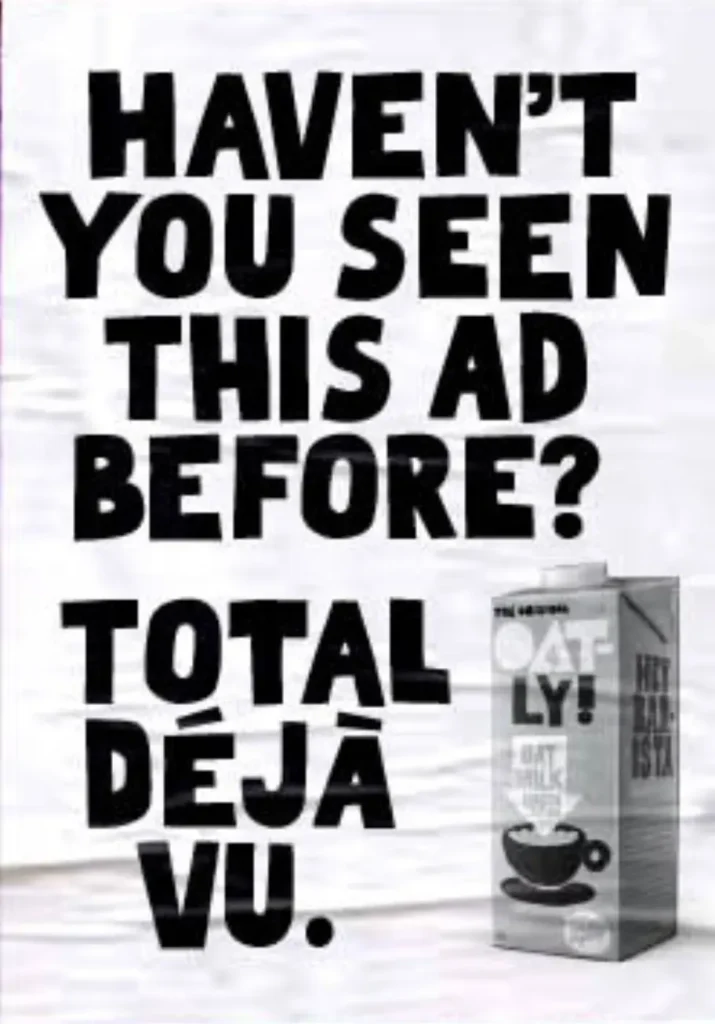
“Haven’t you seen this ad before? Total déjà vu.”
A few streets on, another poster picked up the thread.
“And just in case you missed the other ones, we made this one.”
And then, with a wink:
“We made a back-up one too, just to be sure.”
The repetition became the joke, and the joke made the repetition welcome. The street turned into a conversation, and the audience kept reading the next instalment.
The Execution: Multi-Site Domination Across The Inner City
The plan put posters in the precincts that set trends and shape decisions. In Sydney, that meant Marrickville, Enmore and Newtown. In Melbourne, Fitzroy, Collingwood and Northcote. The campaign aimed for multi-site domination in each, with sequential messaging running across locations and large-format, clustered placements building the kind of frequency that makes a brand feel like it is everywhere at once.
This is precinct-led planning, and it is the work street media does best. With precinct targeting and a tool like RockMaps, a campaign can map sites against the exact places an audience overlaps, near cafes, transport, universities and live music, then concentrate the buy where it counts. Australian cities are built for this approach. They are medium-density, with clearly defined inner-city precincts that each carry their own character and foot-traffic patterns, which is what makes owning one of them feel like owning a moment in culture. Large-format, clustered street posters and billboards gave the run a real sense of scale alongside the saturation.
The Results
For a brand that started with almost no consideration, the campaign read as a category being built in real time. The numbers tell the story:
- 13 million+ earned impressions, across city walls and high-traffic pedestrian paths
- 10,000+ coffee redemptions, driving immediate foot traffic to featured cafes
- 4,000+ calls to an ironic 1800-OATFIX hotline
- a 316% increase in media articles, alongside a 270% lift in social posts
- a 700% increase in demand, at a sustained compound annual growth rate of 21%
The street campaign moved people to act, into cafes, onto the phone, and into the conversation online, which is exactly the bridge from presence to performance that a launch brand needs.
Why It Worked
Strip the campaign back and three principles do the heavy lifting. All three travel well to other brands.
1. Frequency built mental availability
Seeing the brand again and again in the places where the behaviour happens meant OATLY came to mind at the point of decision. Mental availability is precisely that: the brand surfacing easily when someone is choosing within the category, and high-frequency presence is one of the most reliable ways to build it. It is why effectiveness-minded marketers keep returning to the medium. Russel Howcroft, who has spent a career on what makes advertising pay back, stands behind street posters as a strong driver of return for exactly this reason.
2. Contextual relevance puts the message in the right place
A poster near the cafe reaches someone in the ritual, rather than being scrolled past, so the setting itself does some of the persuading.
3. The creative was made for the street
The posters were designed for the medium: simple, bold, high-contrast, and built to be read at a glance and at speed. That is a different craft from resizing a digital ad, and it is what let the sequential idea land. Creative made for the street plays to its strengths: presence, repetition and a bit of wit, and it rewards a brand that briefs for the medium from the start.
What Marketers Can Take From This
You do not need to be selling oat milk for this to apply. Street posters earn their place whenever the brief calls for building mental availability quickly in defined places: a launch, a new category, a challenger brand making itself known, or a push to own a city’s inner suburbs for a season. The medium is unskippable, unblockable, and unmissable, which is a rare and useful thing to say in 2026.
If you take one practical lesson, take this one: brief the creative for the medium.
Keep the message simple and bold; lean on high contrast and readability; plan for repetition and frequency; and make the work location-specific so it belongs to the street it sits on. Do that, and a precinct stops being a list of sites and starts being a stage.
Plan Your Own Precinct Play
Have a launch or a category push on the horizon? Talk to the Rock Posters team about a precinct strategy built around your audience.
Enquire online for a free quote, and we will help you build something truly unmissable.
Author: Paul D. Frehley
Rock Writer (Paul D. Frehley) is the editorial voice of Rock Posters, Australia’s independent out-of-home media network with printing facilities in Sydney and Melbourne. Since 1986, we’ve helped brands, events, and cultural institutions — including the National Gallery of Victoria, the Sydney Film Festival, and the Australian Museum — show up where their audiences already are. We cover campaign strategy, creative execution, and the thinking behind effective street-level and large-format advertising. As an award-winning sustainability leader, we’re also committed to making outdoor advertising better for the communities and environments where we work.