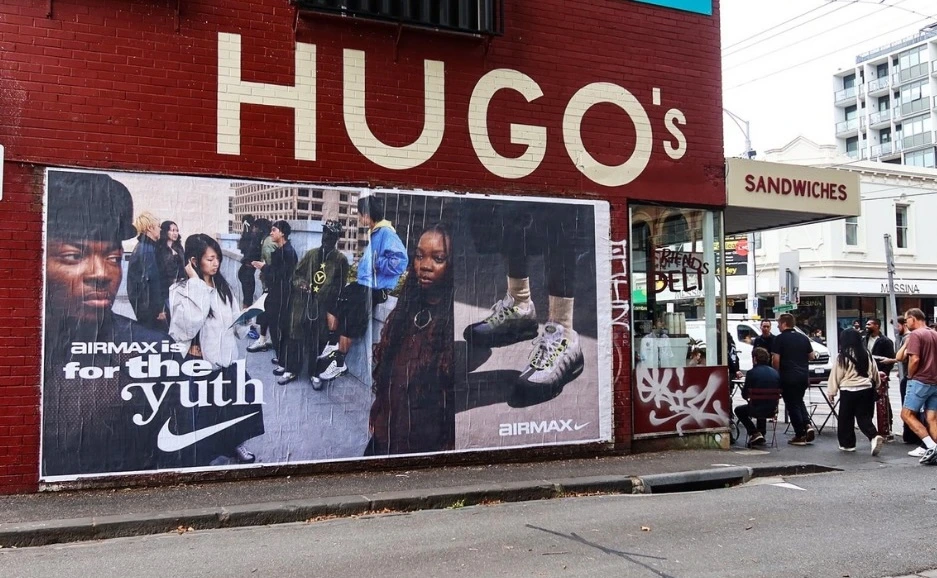
Most retail business owners spend money on a range of different advertising and hope sales go up. But here’s the problem: Did the ads actually drive people into the store?
Many retail marketers say that measuring foot traffic is essential to justify advertising spend—yet only a minority have a systematic process in place. That gap creates doubt and missed opportunities to scale what actually works.
Why Measuring Foot Traffic from Your Outdoor Advertising Matters
As we already know, sales are influenced by dozens of factors—online traffic, competitors, weather, promotions, seasonality, staffing changes. When you spend $2,000 on a street poster campaign, and sales tick up 8%, how can you measure a direct correlation?
Design, location, and timing all influence the outcome, but a lift in foot traffic can be the first concrete evidence that your ad actually moved people to action.
Around 42% of Australian shoppers are omnichannel, meaning they use both digital and physical channels during the shopping journey. This means physical store visits are often influenced by earlier marketing touchpoints such as outdoor advertising.
Outdoor advertising also often sits at the awareness stage, prompting people to:
- Search the brand online
- Visit a store later
- Look up reviews or prices
But starting by measuring foot traffic helps retailers understand whether a campaign is actually driving people into nearby stores, enabling more accurate attribution and better-informed marketing decisions in an increasingly data-driven retail environment.
How to Measure Foot Traffic
Method 1: Manual Door Counting & Zone Tracking
Manual counting sounds old-school, but it’s also the most direct way to know exactly what happened.
- Pick a baseline week with no campaign running. Count every customer who enters your store during peak hours (typically 10 AM to 6 PM weekdays; 9 AM to 5 PM weekends).
- Tally for 7-10 days to smooth out day-to-day variation. Calculate a daily average.
- Run your street poster or billboard campaign for 2-3 weeks.
- Count the same way during the campaign, using the same hours and methodology.
Campaign average minus baseline average equals foot traffic lift. Example: 165 visits/day during campaign minus 150 visits/day baseline = +15 visits, or +10% lift.
Weather, local events, competitor activity, and staffing changes can absolutely affect foot traffic. Noting any variables before analysing your campaign’s performance are highly recommended.
Method 2: Promo Code & QR Code Attribution
This method isolates people who saw your ad and acted on it from people who just wandered by. Print a unique QR code or promo code on your street poster. Track how many people scan the QR code or redeem the code at the register. Boom—you’ve measured engagement from your ad.
QR code saturation is a very real experience amongst Australian consumers, meaning that they aren’t as effective in the outdoor advertising format as we’d think. But if sending your audience to your website to purchase tickets or products is the core action you require them to take, an attributed link or promo code should be available to them.
To isolate audiences, you could offer in-store promo codes, unique to each site and presented only at the door or in-store. Additionally, your outdoor advertising campaign could showcase a QR code that sends scanners to your website with an appropriate URL attribution.
Method 3: Foot Counter Hardware (Passive Counters)
Foot counter devices (thermal sensors, infrared beams, pressure mats) count every person who enters. Set them up, forget about them, and let data flow into your cloud dashboard.
Mount a thermal sensor above your main entrance or position an infrared beam across the doorway.
Export the data and compare the campaign-week average to the baseline-week average. Calculate lift percentage. Overlay campaign dates with traffic spikes to see if your ad correlated with increases.
Method 4: Sales Data Attribution & Incrementality Testing
This method uses before/after POS data or compares stores running your campaign (test) against stores not running it (control). By isolating the test vs. control groups, you neutralise external factors—competitor activity, weather, sales promotions—that affect both groups equally.
How it works:
- Divide your store network into test group (campaign running) and control group (no campaign).
- Run the campaign for 4+ weeks locally to test stores only.
- Measure same-store-sales lift (not just foot traffic, but actual revenue).
- Calculate lift: (Test store sales increase – Control store baseline) = incremental revenue from the campaign.
Use econometric modelling to isolate outdoor advertising impact from price changes, competitor activity, seasonality, and other variables. This is the “gold standard” for proving ROI, but it requires statistical power. You need either a large store network (20+) or a long measurement period (8+ weeks) to be confident in your results.
Method 5: Customer Surveys
Some campaign goals are harder to measure directly, particularly brand awareness or shifts in perception. In these cases, simple surveys can provide useful insights. Consider asking new customers questions such as:
- “How did you hear about us?”
- “Have you seen our posters or billboards recently?”
- “Where did you first learn about our brand?”
Even informal responses collected at the register, through email follow-ups, or via online surveys can reveal patterns in how customers discovered the business.
Over time, these insights help marketers understand which advertising channels are consistently influencing new audiences.
Common Challenges & Accuracy Limitations in Foot Traffic Measurement
Challenge 1: Weather & External Factors
Rain and storms suppress foot traffic 5–15% independent of advertising. Extreme heat (40°C+) can drop retail traffic 30%. On extreme-heat days, the question becomes: Is your ad failing, or is the weather killing traffic?
Solution: Measure baseline and campaign periods in the same season. If you run a campaign in July, measure July–August, not comparing July to February. Document rain days, extreme heat, and floods. If an abnormal event occurs during your campaign, extend measurement by 1–2 weeks post-event to filter out noise.
Challenge 2: Statistical Noise in Small Samples
A single store with 150 daily visitors has high variance. Day-to-day noise might be ±10%. A 3% measured lift could be noise rather than a real change.
Solution: Run campaigns for 4+ weeks (not 2 weeks). Measure across multiple stores if possible. Aim for lifts >8% to be confident. If your lift is 3%, extend the campaign or add stores to build statistical power.
Challenge 3: Attribution Mixing
Customers don’t see your poster in isolation. They might find you via Google, Instagram, or word-of-mouth on the same day. The increase in foot traffic gets “blamed” on multiple channels.
Solution: Use promo codes unique to outdoor ads (QR on poster only, or “mention where you heard about us”). Run campaigns with a clear, urgent offer (time-sensitive lift creates clear attribution). Use control groups: divide stores into test (campaign running) and control (no campaign). This is the gold standard for attribution certainty.
Challenge 4: Seasonal & Cyclical Effects
Retail foot traffic in December is 30–50% higher than in September. Comparing a campaign running in peak season to one in the off-season is tricky.
Solution: Use year-over-year comparison (December 2024 ad vs. December 2023 baseline, same time, same calendar). Control for seasonality in statistical models.
Other Ways to Measure Outdoor Advertising Campaign Success
Foot traffic is often the first signal that an outdoor campaign is working. But in many cases, the real impact is felt through other channels: online searches, ticket sales, social engagement, and overall brand awareness.
No single metric captures the full impact of an outdoor campaign.
According to research from Nielsen and the Outdoor Media Association, out-of-home advertising frequently triggers follow-up digital behaviour, particularly online searches and website visits. This means the true effect of a campaign may show up well beyond the physical location where the poster or billboard appears.
For example, one of the most common responses to outdoor advertising is digital curiosity. A person sees a poster while commuting, then later searches the brand on their phone or visits the website directly.
To measure this effect, track Google Analytics website sessions before, during, and after the campaign period. You can monitor branded search volume in Google Search Console (e.g. people searching your business name) and compare traffic spikes to the dates and locations of your poster placements.
The most effective marketers, therefore, track a combination of signals, including:
- Foot traffic
- Website visits
- Sales revenue
- Event attendance
- Social media engagement
- Customer feedback
Ready to Measure Real Results?
The best street poster and billboard campaigns are measured campaigns. You’ll know what worked, why it worked, and exactly how to spend next time.
Get a custom quote from Rock Posters →
We’ll get back to you within 1 business day with a tailored campaign recommendation and measurement framework for your retail business.

Author: Paul D. Frehley
Rock Writer (Paul D. Frehley) is the editorial voice of Rock Posters, Australia’s independent out-of-home media network with printing facilities in Sydney and Melbourne. Since 1986, we’ve helped brands, events, and cultural institutions — including the National Gallery of Victoria, the Sydney Film Festival, and the Australian Museum — show up where their audiences already are. We cover campaign strategy, creative execution, and the thinking behind effective street-level and large-format advertising. As an award-winning sustainability leader, we’re also committed to making outdoor advertising better for the communities and environments where we work.