Key Insights
- NSW goes to the polls on 13 March 2027, and Victoria on 28 November 2026. Most other states and territories have fixed dates you can plan back from.
- Name recognition can lift a candidate’s support on its own. Randomised field trials in the US found campaign signs added an average of 1.7 percentage points to the advertised candidate’s vote share.
- A quarter of Australians now don’t identify with any party, up from 14 per cent in 2010 (Australian Election Study, 2025).
- Nearly half of Victorian voters (48.72 per cent) voted in person before election day in 2022. Your posters need to be up before early voting opens.
- Election periods put every campaign in the same precincts at the same time, so book sites ahead.
An election campaign has a short window to make an impression, and that window is getting shorter. For example, at the 2022 Victorian state election, 48.72 per cent of voters cast their ballot in person before election day, according to the Victorian Electoral Commission. For many voters, the campaign ends a week or two before Election Day.
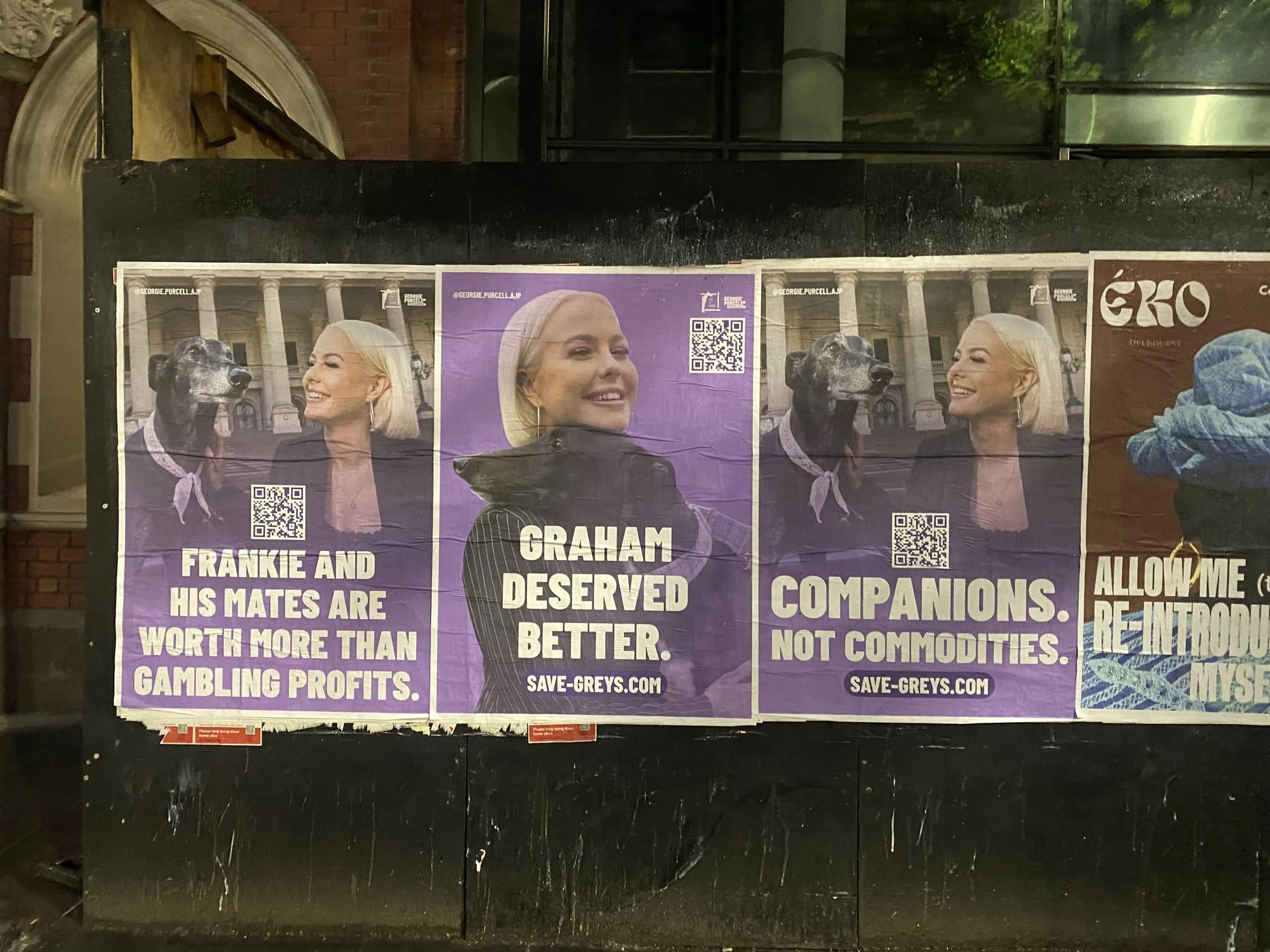
Out-of-home (OOH) advertising has played a part in campaigning for decades. Over time, people need to recognise your name, understand what you stand for, and see your campaign where they live, work, and shop within your electorate. Street posters quite literally do that at street level. They’re particularly useful for candidates voters don’t yet know, including newcomers, minor parties, and independents.
This guide covers the dates to plan around, how far ahead to book, which formats suit different parts of an electorate and how to design posters that work at a glance. With 3 months to go for NSW polls, this guide arrives at the perfect time.
1. Key Dates to Plan Around
Election campaigns run to fixed deadlines, but you should start planning well before polling day. When the confirmed budget allows, it is worth working backwards from the election date to allow time for site bookings, artwork, approvals and production.
The table below outlines upcoming Australian election dates and planning considerations.
| Jurisdiction | Next General Election | Planning Note |
| Victoria | 28 November 2026 | Early voting runs from 18 to 27 November. Check the Victorian Electoral Commission. |
| New South Wales | 13 March 2027 | Check the NSW Electoral Commission. |
| Queensland | 28 October 2028 | Check the Electoral Commission of Queensland. |
| Northern Territory | 26 August 2028 | Check the NT Electoral Commission. |
| Australian Capital Territory | 21 October 2028 | Check Elections ACT. |
| Tasmania | By 2029 | Check the Tasmanian Electoral Commission. |
| Western Australia | 10 March 2029 | Check the Western Australian Electoral Commission. |
| South Australia | 16 March 2030 | Check the Electoral Commission of South Australia. |
| Federal | Date not fixed | Check the Australian Electoral Commission. |
Election dates and voting arrangements can change, so always check the relevant commission for the most up-to-date information. For example, NSW had brought forward their election by two weeks to avoid the Easter long weekend in 2027.
2. Why Street Posters Historically Work for Campaigns
Before a voter can support a candidate, they need to know who’s running. Research shows that name recognition alone can boost support. In experiments published in the American Journal of Political Science, researchers Cindy Kam and Elizabeth Zechmeister (2013) found that exposure to a candidate’s name increased support for that candidate, largely because a familiar name reads as viable.
That familiarity matters more as fewer voters arrive with their minds made up. The 2025 Australian Election Study, run by ANU and Griffith University, reports that the share of Australians who don’t identify with any party has grown from 14 per cent in 2010 to 25 per cent in 2025. These voters are open to persuasion, and campaigns often reach them in familiar settings.
Researchers have also tested street-level campaign material in the field. Across four randomised experiments covering 376 voting precincts in the United States, Green and colleagues (Electoral Studies, 2016) found that campaign signs lifted the advertised candidate’s vote share by an average of 1.7 percentage points. They also found some evidence that the effect spilled into neighbouring precincts. That’s a modest gain, but in a marginal seat a point or two can decide the result.
Where you place posters matters as much as how many you put up. You might prioritise a town centre, a busy shopping strip or the streets connecting key precincts in your electorate. Our Rock Maps planning tool maps poster sites against local, state and federal electoral boundaries, so your campaign appears inside the electorate you’re contesting, not the one next door. Our network covers Melbourne, Sydney, Brisbane, Adelaide and Perth.
A coordinated poster run then links each site through a consistent name, colour palette and message. As people move through familiar parts of the electorate, they see the same visual identity again and again, and that repetition is what makes a campaign recognisable. The same US trials found that, in some cases, signs naming a party were less effective. Leading with the candidate’s name and face is a sound default.
3. Your Campaign Timeline
Working back from polling day keeps site booking, artwork and production moving together. Early voting moves that date up, so plan to the start of early voting, not just election day.
3+ Months Out: Brief, Budget and Site Booking
Election periods compress demand. Candidates across every party, plus issue and advocacy campaigns, often want the same precincts in the same weeks. Booking early secures your priority sites.
Start with your electorate, priority suburbs, objective, budget and run dates. Our team can map available sites against your electoral boundary and show you what’s free in the precincts that matter.
Decide how much creative you need, too. One strong message may suit a focused campaign. Several coordinated designs can work if you’re speaking to different issues in different parts of the electorate.
2 Months Out: Artwork, Internal Sign-Off and Print
Give your designers the physical poster dimensions before they finalise files. A design that looks good on a laptop still has to work from across the street, where people read it in passing.
Allow time for sign-off. Campaign committees, party approvals and candidate checks can take longer than the design itself. Check our poster specifications before sending artwork to print, so files arrive production-ready.
Before Early Voting Opens
Early voting has reshaped the campaign calendar. In Victoria, it grew from 16.33 per cent of voters in 2010 to 48.72 per cent in 2022 (VEC). In NSW, election analyst Antony Green estimated early voting rose from 26 per cent of enrolment in 2019 to between 30 and 38 per cent in 2023.
Put your posters up before pre-polling centres open, then keep them up through polling day. An average street poster campaign lasts 2-4 weeks depending on budget, timeline and availability.
After Polling Day: Campaign Wrap-Up
Once polling closes, close out the media run and production records while the details are still fresh.
If OOH formed part of a broader media plan, include it in your final campaign review alongside your other channels.
4. Choosing Formats and Sites
The right format depends on your campaign objectives, audience and geography. You don’t need the biggest format everywhere; you need a mix that suits the locations you’re trying to reach.
Street Posters for Local Coverage
Street posters help build a presence across selected precincts. A series of sites can connect different parts of an electorate, giving your campaign visibility in the areas you’ve prioritised.
Use your geographic focus to guide the site plan rather than spreading the budget across locations that matter less to the campaign.
Let the shape of the electorate guide the mix. Dense inner-city seats with busy shopping strips suit a series of street posters across connected precincts. Outer suburban and regional seats with long arterial roads may get more from adding billboards for scale.
Billboards for Additional Scale
Larger billboard placements can add visibility along major arterial routes. They offer another option to complement your street poster run with additional scale.
We offer supersite billboard opportunities alongside our street poster network, so you can consider how the formats work together within your wider OOH plan.
B0 Versus A0 Posters
Size affects how your creative works in the real world. Our standard street poster is B0, measuring 1,000 mm × 1,400 mm, which is larger than the traditional A0 format.
That extra space gives you more room for a candidate’s name, a recognisable image and a short campaign message. It doesn’t mean you should fill every centimetre.
You might use B0 street posters across priority precincts, then add larger billboard placements where additional scale is useful. Explore our network and poster specifications when planning your coverage and formats.
5. Designing Election Posters That Work at a Glance
A campaign poster has a simple job: communicate its main point before someone moves on.
One Face, One Name, One Message
Give people a clear starting point. Make the candidate or campaign name easy to recognise, then keep the primary message short enough to understand at a glance.
Too much copy makes a poster harder to read on a busy street. Choose the most important message and let the design do its work.
Use the name the way it will appear on the ballot paper. Recognition built on the street should carry through to the booth, so avoid nicknames or shortened versions that voters won’t see when they vote.
Make Colour and Typography Work Harder
Strong contrast, readable typography and a clear visual hierarchy help your creative stand out. Colour can make a campaign recognisable, but it needs to work alongside the message rather than compete with it.
For more practical advice, explore our guides to what makes a good poster design, colour theory for street posters and billboard design mistakes to avoid.
If you’re running several campaign posters, keep the visual system consistent across the series. Repeating key colours, typography and imagery helps connect the sites into one recognisable campaign.
Before finalising electoral material, check the applicable requirements for your campaign and jurisdiction.
6. Beyond Candidates: Issue and Community Campaigns
Election-period OOH activity isn’t limited to candidates and political parties. Advocacy groups, not-for-profits and community organisations can also use street posters to bring an issue into public view.
The approach is similar: define your audience, identify the locations that matter, choose your run length and build the creative around one clear message.
A community campaign might concentrate posters around neighbourhoods connected to its cause, giving a limited budget a clear geographic focus.
Posters have a long history of bringing music, culture, causes and campaigns into the streets. We’ve worked across community-focused campaigns and can help plan a poster run around relevant neighbourhoods and audiences.
For more guidance, read A Guide to Running a Community Poster Campaign in Australia.
Plan Your Next Campaign With Rock Posters
Election campaigns move quickly, and early voting means you need to put up your posters before polling day. NSW votes on 13 March 2027. If you’re contesting a NSW seat or running an issue campaign around it, now is a good time to secure sites in your priority precincts.
We’re Rock Posters, an independent, Australian-owned business with production facilities in Melbourne and Sydney and a network covering Melbourne, Sydney, Brisbane, Adelaide and Perth. We work with candidates and causes across the political spectrum.
Get in touch with our team to discuss your campaign, and we’ll help you plan a poster run around your electorate, budget and timing.Speak to the Rock Posters team about your campaign, suitable sites and a quote for your summer run.
Author: Paul D. Frehley
Rock Writer (Paul D. Frehley) is the editorial voice of Rock Posters, Australia’s independent out-of-home media network with printing facilities in Sydney and Melbourne. Since 1986, we’ve helped brands, events, and cultural institutions — including the National Gallery of Victoria, the Sydney Film Festival, and the Australian Museum — show up where their audiences already are. We cover campaign strategy, creative execution, and the thinking behind effective street-level and large-format advertising. As an award-winning sustainability leader, we’re also committed to making outdoor advertising better for the communities and environments where we work.