Key Insights
- Digital printing posters suit short runs, fast turnaround and artwork that may change
- Screen printing on posters gives access to fluorescent colours, strong ink coverage and a distinctive printed finish
- Offset printing can suit larger, fixed runs where setup costs are spread across volume
- The production choice comes down to colour, stock, quantity, timing and budget
Street posters are one production choice within a broader out-of-home (OOH) campaign, and the printing method behind them can affect colour, stock, turnaround, and cost.
For most campaigns in 2026, digital printing is the practical option. It suits short runs, fast production and artwork that may change. Screen and offset printing come into the picture when a campaign needs something different, whether that is a fluorescent colour, a particular stock, a substantial fixed run or a specific printed finish.
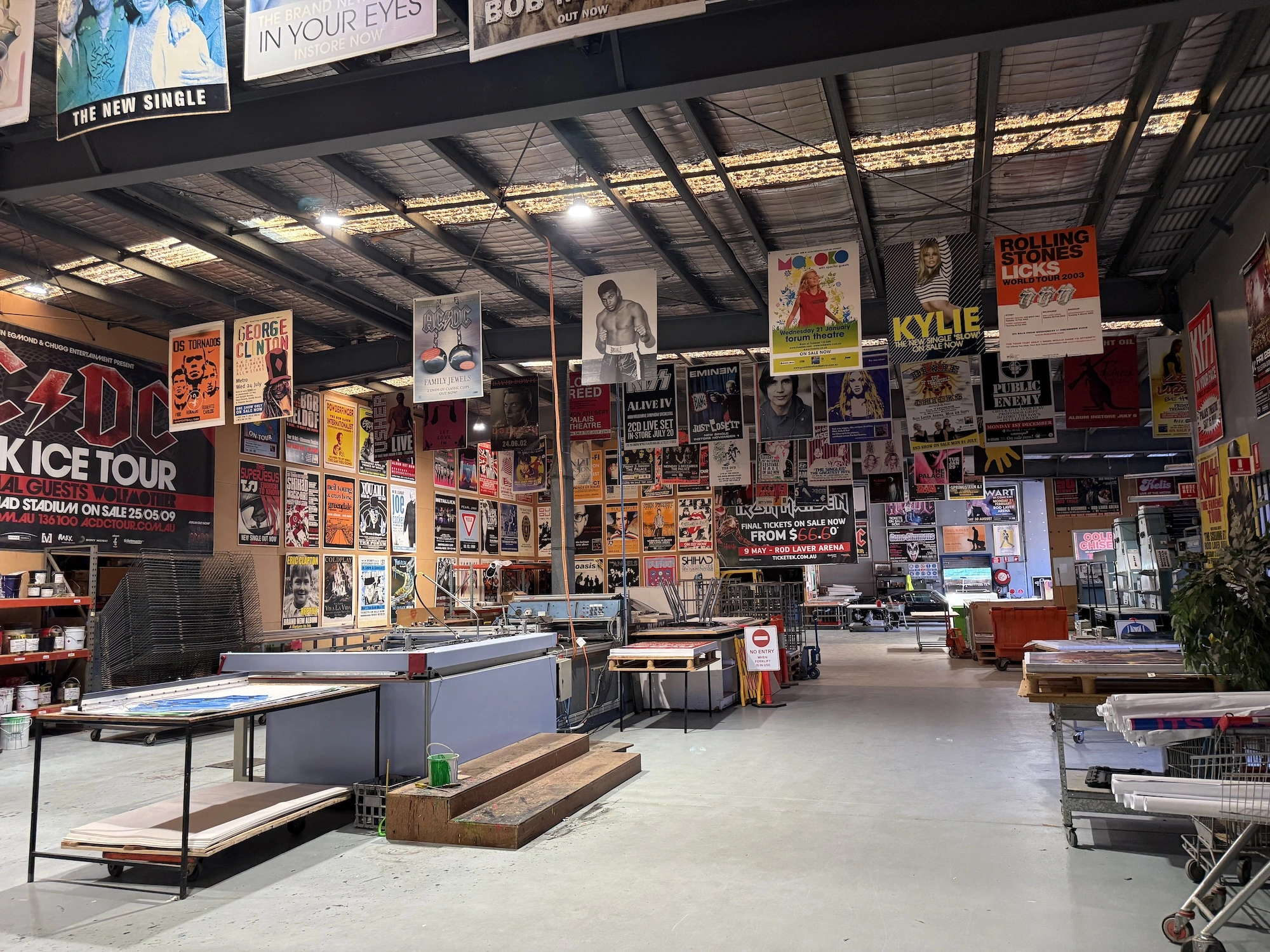
Rock Posters has worked with analogue printing since 1986. The technology has changed over the past 3 decades, but some of the reasons for using analogue processes have not.
Analogue Printing Definition
An analogue printing process uses a physical intermediary to transfer an image onto stock, requiring manual labour throughout the entire process.
Modern digital printing removes much of that physical preparation. The artwork moves through a digital workflow and onto the printing system without the same screen or plate setup.
There are several analogue printing processes, including:
- Screen printing
- Lithographic printing
- Letterpress printing
- Riso printing
They use different methods and produce different results, but the distinction is simply that analogue printing uses a physical stage between the artwork and the final stock. This physical stage often requires bulky machinery operated by an experienced printer who manually calibrates, prints and maintains the process.
For a street poster campaign, that difference can affect what you can print, how many you need to produce and how quickly you need them.
Rock Posters has used analogue production since 1986, when screen printing was at the centre of our poster work. Today, those traditional processes sit alongside digital production.
What Is Offset Printing?
Offset printing transfers an inked image from a plate onto a rubber blanket, which then transfers it onto the paper or other stock. That extra step is what gives offset printing its name.
Offset is high quality, can accurately reproduce fine details, and is exceptional at Pantone colour matching. In 2026, modern offset printing presses and their technology enable more efficient plate preparation and reduce water consumption, chemical use, and setup waste. At Rock Posters, we can use vegetable-based inks on our “Green Posters” with our offset printing press and recycle the plates by the skipload, turning a once-wasteful analogue process into a sustainable printing option.
Offset requires setup, so it becomes more attractive when that preparation is spread across a larger, fixed run. Digital printing tends to have an advantage when you need shorter runs, multiple versions or fast changes.
The process of offset printing involves:
- Digital file preparation – all artwork is supplied digitally, meeting the required artwork specs of the printing facility and equipment.
- Plate preparation – the artwork’s design is etched onto metal plates via a chemical process. A fresh metal plate is used for each colour and page.
- Ink application – ink is applied to the etched metal plates, adhering only to the elements etched on that plate.
- Offsetting – the inked area is pressed to a rubber sheet, then rolled onto the paper.
- Drying – freshly printed posters are then set aside to allow for the ink to dry.
Our offset printer only prints B0 “standard” posters 1400 x 1000 (aka 2 sheeters), with the minimum run on that machine being 200.
Understanding Screen Printing
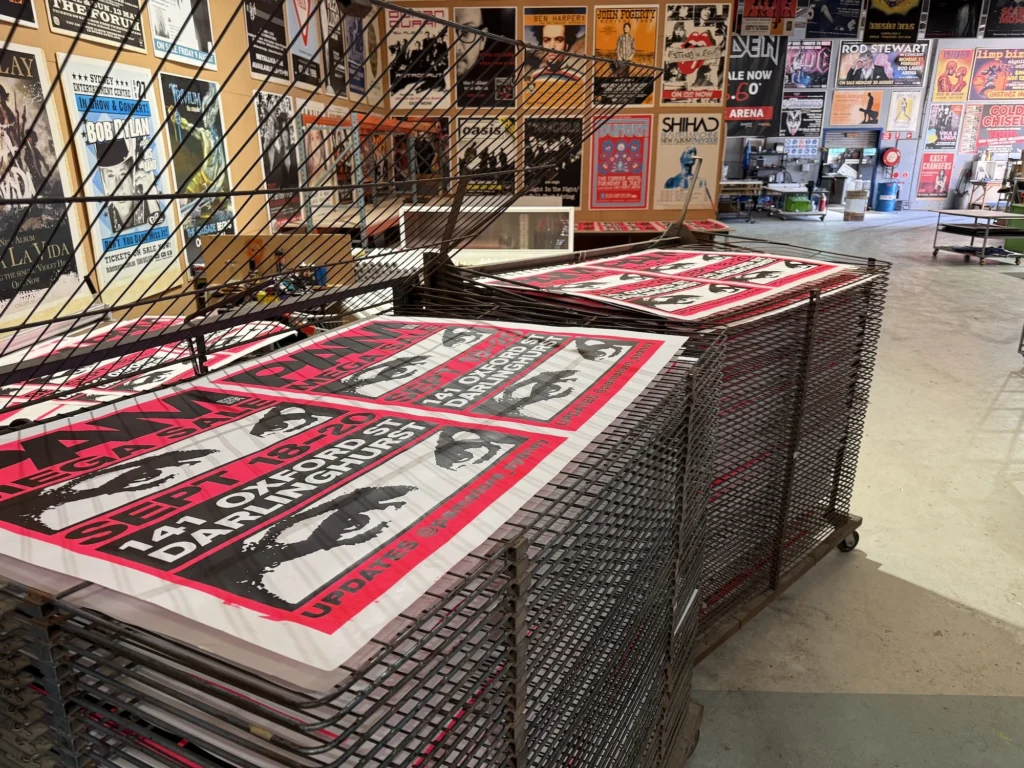
Screen printing is a traditional analogue printing process where an image is transferred onto stock by pushing ink through a prepared mesh screen. Because each individual colour in a design requires its own separate screen preparation and printing pass, the process is inherently more involved than digital alternatives.
Screen printing’s uniqueness lies in its distinctive, high-quality physical finish and heavy ink coverage. Most notably, it remains the primary method for producing vibrant fluorescent colours that modern digital presses often cannot match. This produces a punchy, tactile result that gives posters a specific physical character and personality.
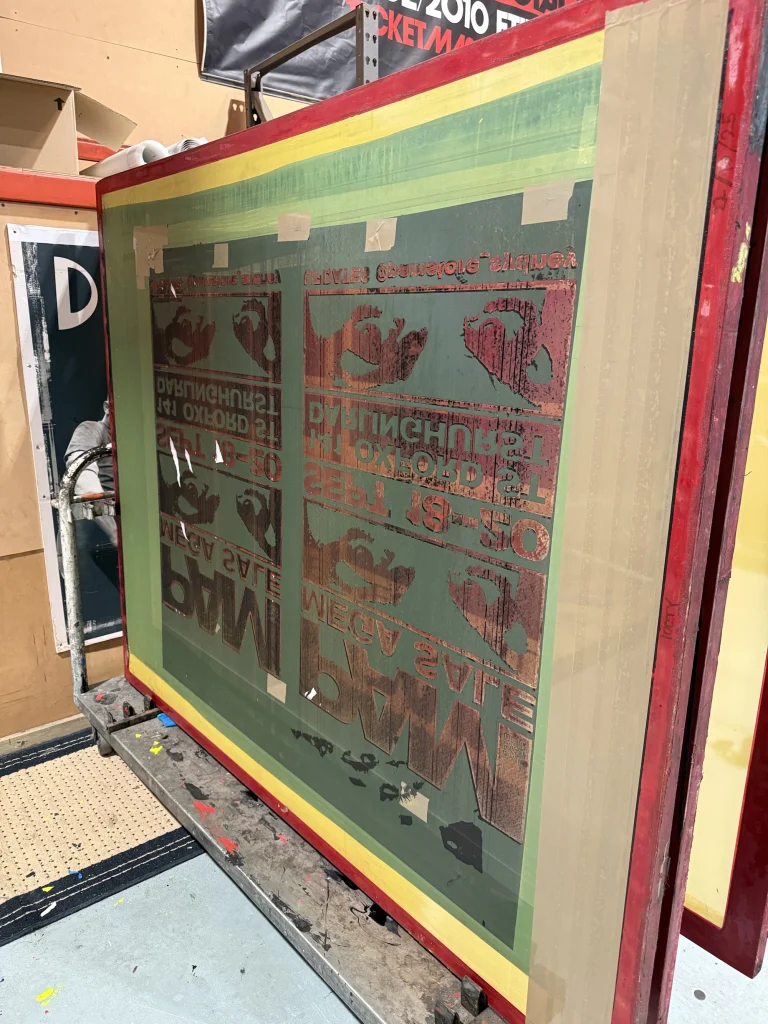
Compared to streamlined digital workflows, screen printing is significantly more labour-intensive. It requires extensive manual setup, including coating screens with emulsion, exposing them to UV light, washing, drying, and mounting them for the press. This physical nature means small manual imperfections, such as ink smears or flap-ups, can occur, though these are often viewed as part of the medium’s appeal.
Today, Rock Posters opts for screen printing when a project demands that unique physical look or specific specialist colours. While digital printing is the faster and more flexible choice for short runs or rapid changes, screen printing remains the go-to for clients who want the bold, collectible feel that only a physical analogue process can provide.
The Darkroom
While the darkroom remains a part of the screen-printing workflow at Rock Posters, its role has evolved. Historically, the darkroom era involved complex camera work and processing film into positives, a stage that often required sending work to external film bureaux.
In the early 2000s, that dedicated film-processing industry was effectively replaced by digital workflows and the arrival of the Epson printer. However, the darkroom environment remains essential to the physical side of production; it is still used to coat screens with emulsion and expose them to UV light before washing and preparing them for the press.
While dedicated industrial darkrooms used purely for commercial film positives have mostly disappeared, screen printers still use the space today for exposure, and artists and photographers dedicated to the craft of analogue film development.
Hand-Cut Stencils And Hand-Drawn Artwork
Before the dominance of digital design, creating a street poster was a manual, physical craft. For printers at Rock Posters, this meant ‘hand-cutting’ stencils using blades to cut intricate shapes, letters, and graphics into film or paper masks. They then used these masks to block out areas of the screen. Every element had to be physically rendered and cut by hand, a process that demanded immense precision, steady hands, and significant time. If a knife slipped, the stencil was ruined, making the preparation phase just as critical as the actual printing.
Similarly, artists often drew artwork directly onto film or translucent paper. This gave the final prints a distinct, tactile quality, preserving the subtle, idiosyncratic “imperfections” of the artist’s own hand.
While Rock Posters no longer uses hand-cut stencils commercially, those techniques remain a foundational part of the medium’s history. They now mainly appear in personal art projects, preserving a skill set that defined the industry in the 1980s.
That history is woven into Rock Posters’ identity. When we began screen printing in 1986, much of our work was for bands and artists who valued that physical, hands-on aesthetic. While the workflow has shifted to digital, that connection to poster art, music, and street culture remains central to our legacy.
Where Analogue And Digital Meet Today
In 2026, the intersection of digital efficiency and analogue craft has redefined the possibilities for poster production. This hybrid workflow leverages the best of both worlds, creating a seamless bridge between modern design and traditional tactile output.
At the front end, digital technology provides unprecedented precision. Designers can create intricate, multi-layered artwork, experiment with complex colour separations, and perfect compositions in real-time. This digital foundation means that even highly complex designs can be output onto film positives with absolute accuracy.
The transition to analogue begins the moment that the digital file is output. The digital film positive acts as a map, allowing the printer to expose screens that capture the exact digital intent, but with the material reality of the screen-printing process. When the screen is on the press, the printer controls ink viscosity, squeegee pressure, and registration—manual variables that create the unique, tactile finish associated with analogue prints.
By treating the digital workflow as the architect and the analogue press as the artisan, we can achieve results that were previously difficult to balance: precise, photographic detail combined with vibrant, opaque fluorescent inks or heavy ink coverage.
When An Analogue Process Is The Right Call
Analogue printing makes sense when the production method gives the campaign something it needs. That might be:
- Fluorescent or specialist colours your digital press cannot produce
- A particular stock that suits the process
- Strong ink coverage that supports the creative
- A fixed, substantial run where offset is worth pricing
- Collectable or fine-art poster work where the physical character matters
- A specific screen-printed look requested by the client
Digital will still be the better option for many street poster campaigns. If you need a short run, several versions, fast turnaround or artwork that may change right up until launch, digital keeps production simpler.
Your print run also needs to match the media plan. A street-poster campaign might use a network of sites, with posters rotated or replaced throughout the campaign. If you are planning paste-ups across multiple locations, the number of posters you need and how often they will be replaced will affect the production volume and turnaround.
Plan Your Next Campaign With Rock Posters
Digital often suits campaigns that need speed, flexibility, and shorter runs. Screen or offset can suit jobs where colour, volume, stock or the physical character of the print calls for a different approach.
Rock Posters has worked across these production methods since 1986. That experience gives the team a practical understanding of what each process can do and where it fits.
If you’re planning a tour, festival, exhibition, retail launch or brand campaign, consider the creative, run length, stock, colour requirements and timing before asking about a specific printing method.
Planning your next street-poster campaign? Speak to the Rock Posters team about your requirements and get a quote for your next run. If you are shaping your next out-of-home campaign, static street posters deserve a place on the plan. Discuss your upcoming campaign with our team today.
Author: Paul D. Frehley
Rock Writer (Paul D. Frehley) is the editorial voice of Rock Posters, Australia’s independent out-of-home media network with printing facilities in Sydney and Melbourne. Since 1986, we’ve helped brands, events, and cultural institutions — including the National Gallery of Victoria, the Sydney Film Festival, and the Australian Museum — show up where their audiences already are. We cover campaign strategy, creative execution, and the thinking behind effective street-level and large-format advertising. As an award-winning sustainability leader, we’re also committed to making outdoor advertising better for the communities and environments where we work.