Key Insights
- In Australia, wild posting is called wheatpaste posters or street posters.
- Australia’s major cities are strong markets for street-level advertising. Dense inner-city precincts, high foot traffic, and culturally engaged urban audiences make campaigns here genuinely effective.
- The professional Australian market operates on permitted sites.
- Street poster distributors, such as Rock Posters, install contracted locations across every major city.
- International brands can work with local printers and distributors to run a successful campaign here. Send your artwork, brief the team on your objectives, and we handle production, placement, and documentation nationwide.
If you’re searching for wild posting in Australia and coming up short, there’s a reason for that.
In the US, it’s wild posting. In the UK, fly posting. Here in Australia, the industry calls it street posters (or billboards for megasites and supersites).
If you’re an international brand or campaign manager trying to run street-level advertising across Sydney, Melbourne, or Brisbane, that terminology gap is just the beginning of what you need to understand before you start.
Australia is one of the most compelling markets in the world for this kind of campaign. Our city centres are dense, walkable, culturally engaged, and have a genuine appetite for music, fashion, events, and brands that orbit those spaces.
What Wild Posting Is (And Why It Works Everywhere)
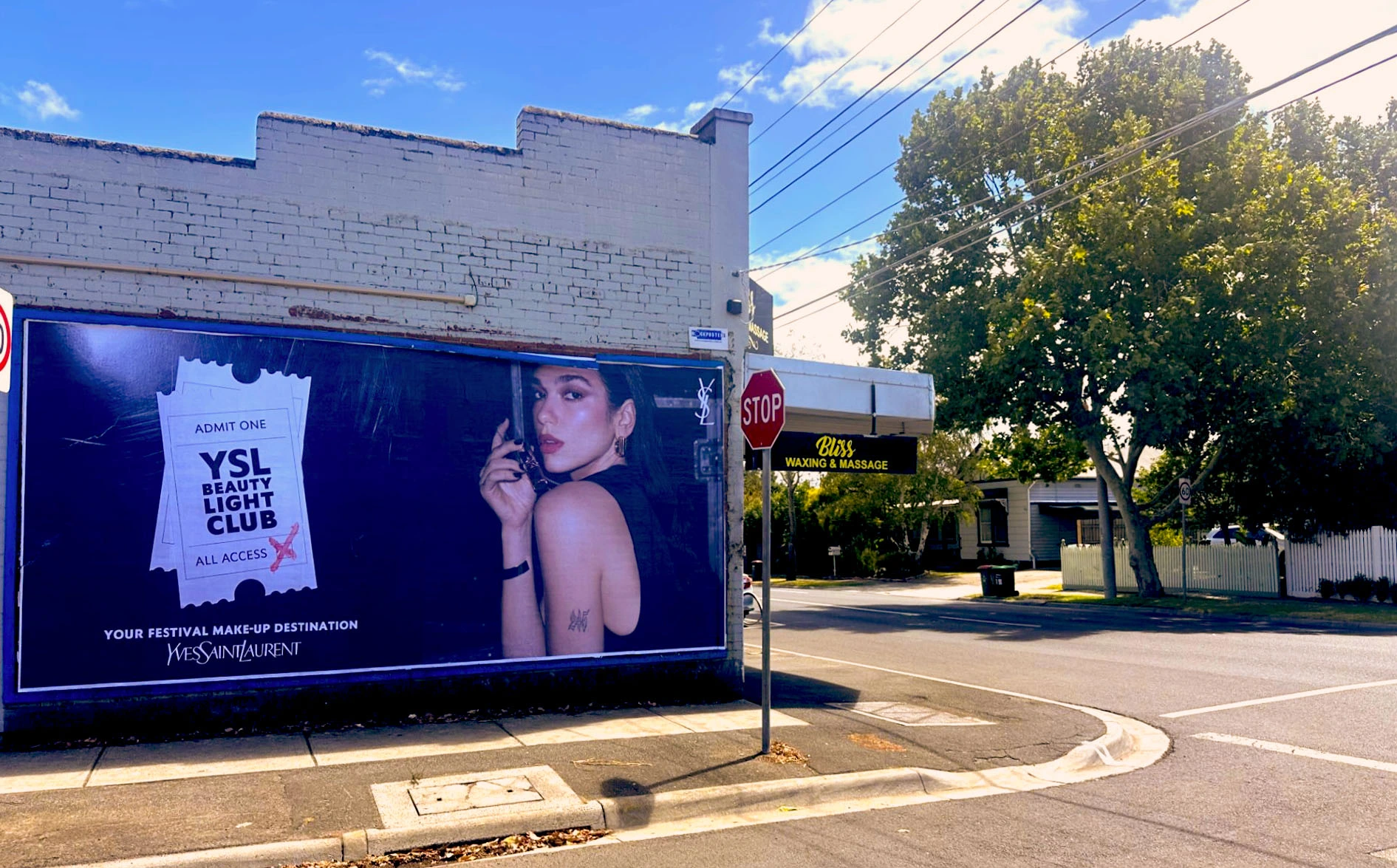
Wild posting (or wheatpaste advertising) is large-scale street-level poster advertising. Large-format printed posters are applied directly to walls, construction hoardings, and approved surfaces across high-traffic urban areas.
The power of the format comes from repetition and proximity: posters clustered across a neighbourhood, seen multiple times by the same person over weeks, building brand recognition through physical presence that can’t be scrolled past, muted, or blocked.
The music industry in Australia notably refers to street posters as 2-sheeters and 4-sheeters due to their repetitive format.
Globally, the format has been used by brands ranging from Nike and Calvin Klein to independent music artists and major film studios.
In 2021, Fortnite ran a synchronised global campaign across eight major cities simultaneously, including Sydney, with region-specific creative in each market and all posters going up at exactly midnight local time.
More recently, Charli XCX’s BRAT campaign became one of the most talked-about street poster moments in recent memory. The iconic neon-green BRAT walls have spread internationally, with locations in Sydney, Melbourne, and Brisbane. Content from the walls exploded on TikTok, with fans filming themselves at the installations and the posts reaching audiences well beyond those who saw the physical posters
Calvin Klein’s #MyCalvins campaign is another reference point. The poster executions built significant street-level presence in Sydney as part of a broader global rollout, pairing bold photography with a social-first campaign mechanic that extended the posters’ reach far beyond the wall.
Why Australia Is A Strong Market For Street Poster Campaigns
Australia is one of the most urbanised nations on earth. More than two-thirds of Australians live in a capital city, with 40 per cent of the entire population concentrated in Sydney and Melbourne alone. Street-level advertising campaigns, therefore, reach a concentrated, walkable population moving through the same corridors every day.
Sydney alone recorded more than 500 million public transport trips in a single calendar year across its train, bus, light rail, and ferry network— and that figure continues to climb. Across Australia’s major cities, commuters are heading to their workplaces an average of 3.9 days per week in 2024, with around 15 per cent expecting to travel in more often over the coming year.
Additionally, Sydney has almost double the population density of most other Australian cities, with Melbourne sitting halfway between Sydney and the rest. Both cities have dense inner-city precincts where foot traffic is concentrated, and pedestrians are genuinely present and engaged with their surroundings.
The audience wild posting reaches most effectively is also well represented here. People aged 15 to 54 accounted for more than 50 per cent of all high-end spending in Australia as of April 2024. Australian Millennials average $2,400 per month on food, tech, and experiences, with 15 per cent spending growth forecast.
According to Retail Victoria, the combined discretionary spending share of Millennials and Gen Z is forecast to reach 40 per cent of Australia’s total retail market by 2030. These are consumers who are culturally active, socially connected, and spending in the categories that make street-level advertising work.
How The Australian Market Differs From The US
A few things international brands consistently get wrong when they approach Australian campaigns from a US or UK playbook.
Terminology
In Australia, you won’t hear “wild posting” from anyone in the industry. The format is mainly called street posters or wheatpaste posters, and that terminology is consistent across all professional operators in the market.
The Legal Environment Is More Structured
In the US, wild posting broadly involves two approaches: permitted installations secured through property owner approval, and unpermitted guerrilla-style installations that may be subject to removal or a cease-and-desist order.
Australian councils treat unauthorised bill posting seriously. The City of Sydney actively enforces bill poster laws against commercial advertising placed on telegraph poles, fences, hoardings, and building sides without the owner’s consent.
In Adelaide, bill posting (displaying or placing advertising material on property without the permission of the owner or occupier) is illegal regardless of whether the property is council-owned, privately owned, or government infrastructure.
The regulations are state-by-state, but the principle is consistent: unpermitted commercial posting is enforceable, and councils do remove it.
For Rock Posters, we operate on legally contracted sites with pre-approved surfaces maintained specifically for poster advertising, with agreements in place across every city in the network.
Cities Are Geographically Distinct
A campaign in Los Angeles or New York can saturate one continuous urban area. Australian capital cities are built differently. They are medium-density, with clearly defined inner-city precincts that each have their own character, foot-traffic patterns, and audience profiles.
Surry Hills and Newtown in Sydney attract different people at different times than Parramatta. Fitzroy and Collingwood in Melbourne carry a different cultural weight than Southbank. A campaign that ignores this and simply targets “Sydney” or “Melbourne” will underperform.
The ones that work are built around a precise understanding of which precincts your audience actually moves through, and that knowledge comes from decades of placement experience.
City By City: Where Your Campaign Should Run
Sydney
Young professionals aged 25 to 35 make up approximately 16 to 18 per cent of Sydney’s population, concentrated heavily in inner suburbs like Surry Hills, Newtown, Redfern, and Glebe. These are the people street poster campaigns are built to reach, as they are culturally active, socially connected, and spending money on music, food, fashion, and events.
The City of Sydney’s estimated resident population reached 237,278 in 2024, at a density of 8,892 persons per square kilometre — making the inner city one of the most walkable, pedestrian-saturated environments in the country.
Surry Hills, Darlinghurst, and Newtown form the core of Sydney’s creative heartland. Marrickville, further west, has emerged as a cultural hub in its own right — younger, denser, and highly receptive to street-level creativity. The Charli XCX BRAT campaign placed its Sydney activation specifically in Marrickville, and the response reflected exactly that demographic precision. The CBD and Redfern extend reach for campaigns that need broader visibility alongside the cultural inner-west footprint.
Melbourne
Melbourne’s CBD is now the most densely populated area in Australia, with more than 43,000 residents per square kilometre, while the inner-city suburbs of Carlton, South Yarra, Fitzroy, and Collingwood make up Victoria’s top five for density. Melbourne is also, by its own long-standing reputation, the Australian city most attuned to street culture. It is specifically noted for its street art, live music, and theatre scenes in a way no other Australian city is.
Fitzroy has a thriving street art community and is home to Gertrude Contemporary Art Spaces and the Centre for Contemporary Photography. Smith Street, which borders Fitzroy and Collingwood, was named the coolest street in the world by Time Out in 2021.
These aren’t soft claims about “vibes” — they reflect a genuine density of creative businesses, independent venues, and culturally engaged foot traffic that makes street poster campaigns here land differently than anywhere else in Australia. Fitzroy, Collingwood, Richmond, and Brunswick are the core zones. For fashion, music, arts, and entertainment campaigns targeting an engaged urban audience, Melbourne is the strongest environment in the country.
Brisbane
Brisbane is the most underrated market on the East Coast for international brands. Brisbane is the third-most populous city in Australia, with a population of approximately 2.8 million, and lies at the centre of South East Queensland’s urban region with an estimated population of 4.1 million as of 2024. It skews younger than Sydney or Melbourne, and it’s growing fast.
Fortitude Valley is the engine room of Brisbane’s cultural and entertainment scene. In 2005, Fortitude Valley became Australia’s first Special Entertainment Precinct — a designation created specifically to protect live music venues from noise complaints while allowing the entertainment district to continue operating.
By 2012, around 50,000 people were heading to Fortitude Valley’s clubs, pubs, and restaurants each weekend night. That infrastructure makes it one of the most targeted environments in Queensland for music, events, and youth-skewing brand campaigns.
New Farm and West End round out Brisbane’s inner-city precinct options, attracting different audience profiles: New Farm skews toward an affluent, design-aware demographic; West End is culturally diverse and independent-leaning. Together, these three precincts cover most of what international brands need from a Brisbane activation.
Beyond the East Coast
Rock Posters operates across Adelaide, Perth, Newcastle, and the Gold Coast. For street poster campaigns requiring true national coverage, such as product launches, tour announcements, and multi-market brand moments, these cities extend reach into audiences that east-coast-only campaigns don’t touch.
Perth in particular is worth noting: according to the Australian Bureau of Statistics, it recorded the highest capital city growth rate in Australia in the year to June 2024 at 3.1 per cent,with a rapidly expanding inner-city population and a cultural scene that has historically been overlooked by international brands relative to its size and spending power.
Running Your Australian Wild Posting Campaign
If you’re planning an Australian campaign — a one-city launch in Sydney, a national rollout across five capitals, or a globally coordinated drop that includes Australia as a key territory — Rock Posters is the team to call.
Four decades of local expertise. A nationwide network of permitted locations. In-house production in Sydney and Melbourne. A team that understands both the street and the strategy behind it.
Get in touch with the Rock Posters team to discuss your campaign brief. Same-day and next-business-day quotes available.
Author: Paul D. Frehley
Rock Writer (Paul D. Frehley) is the editorial voice of Rock Posters, Australia’s independent out-of-home media network with printing facilities in Sydney and Melbourne. Since 1986, we’ve helped brands, events, and cultural institutions — including the National Gallery of Victoria, the Sydney Film Festival, and the Australian Museum — show up where their audiences already are. We cover campaign strategy, creative execution, and the thinking behind effective street-level and large-format advertising. As an award-winning sustainability leader, we’re also committed to making outdoor advertising better for the communities and environments where we work.