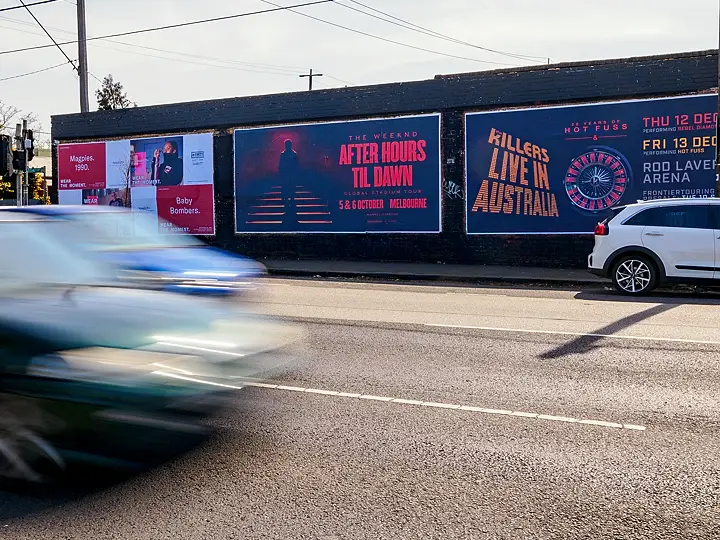
Billboards have been a dominant force in advertising for more than a century, serving as monumental canvases that capture the public’s eye.
Starting as simple, hand-painted signs, they have evolved dramatically over the decades into the intricate, high-tech installations and vibrant digital screens that dominate urban centres today. Despite all the technological advancements in media consumption, billboards have retained their core function and remain one of the most effective and far-reaching ways to capture mass attention at scale.
While digital advertising offers overblown and possibly dubious targeting and measurement, static billboards, or more broadly, Out-of-Home (OOH) advertising, offer an essential counter-balance: guaranteed, unavoidable reach and a sense of permanence that fleeting digital ads cannot replicate. They offer a unique opportunity to build brand authority and generate significant mindshare in high-traffic areas. This comprehensive guide covers everything a modern marketer needs to know about leveraging the power of billboard and outdoor advertising in Australia.
What is Billboard Advertising?
Billboards are part of the OOH advertising category, alongside transit ads and posters. Their core strength is simple: they reach mass audiences, repeatedly, in the real world. Billboard advertising uses large outdoor displays, typically positioned along roadsides, in busy CBD areas, or near high-traffic venues, to promote a brand, product, event, or campaign.
Types of billboards you may frequently see around Australian major and regional cities include:
- Traditional/static billboards: Printed paper or sometimes vinyl.
- Digital billboards (DOOH): Electronic screens that rotate multiple ads.
- Mobile billboards: Ads placed on buses, trams, or trucks.
- Street posters/large-format posters: Smaller but highly visible across neighbourhoods.
Why Do Billboards Still Work in 2026?
1. Unmissable Reach
Unlike online ads, which depend entirely on a user’s device settings, connectivity, and scroll speed, a physical billboard is an unmissable fixture in its environment. It cannot be blocked, ignored, or fast-forwarded.
The average Australian spends over 1 hour a day travelling, and street-level billboards dominate those routes, guaranteeing exposure to everyone who passes by. For commuters who take the same route daily, seeing the same brand message repeatedly embeds it deep in their long-term memory. This sustained, high-frequency exposure is a cornerstone of effective awareness campaigns.
2. Trust & Legitimacy
Consumers are increasingly sceptical of online ads due to scams, clickbait, and AI-generated content. A billboard, by contrast, signals investment and permanence.
Placing a brand on a large-scale, physical structure requires a significant, tangible financial commitment. Consumers interpret this investment as a sign of a credible, stable, and serious business.
Additionally, seeing a brand’s logo and message in the physical world validates its existence and legitimacy far more effectively than a fleeting, anonymous banner ad online. It helps build a foundation of public trust and credibility, invaluable to established and emerging brands alike.
3. Brand Recall
The simple, bold nature of billboard advertising is perfectly tailored for memory retention.
The format demands conciseness. Billboards force advertisers to distil their message into a few impactful words and a strong visual, making the core communication instantaneous and easy to process.
The memory formed from a repeated OOH exposure is strong and often context-free, meaning the brand recognition pops into a consumer’s mind later, whether they are shopping online or standing in a store aisle.
4. Hybrid Campaigns
Billboards aren’t in competition with digital marketing; they complement it. Simple additions like QR codes, unique hashtags, short vanity URLs, or brand-specific short-codes transform a static advertisement into an interactive launchpad.
Additionally, a memorable billboard campaign drives consumers to search for the brand online. This is often referred to as “second-screen” behaviour, where the OOH exposure triggers a subsequent action on a mobile device, effectively generating high-intent, low-cost organic traffic.
How Much Does Billboard Advertising Cost?
Investment can vary dramatically based on a number of key variables, including location, size, format (static vs. digital), and the duration of your campaign. In Australia, generally:
- Major city digital billboards (Sydney, Melbourne, Brisbane):
- $3,000–$50,000+ per 4-week cycle.
- Static billboards:
- $1,000–$10,000 per 4-week cycle, depending on visibility and traffic count.
The final price of a billboard campaign is a result of several interacting variables:
- Billboard site locations and demand
- Size of billboard
- Paste-ups vs. digital
- Size and quality of paper and print
- Duration of campaign
- Investment in design and placement strategy
To obtain an accurate quote, advertisers are encouraged to engage directly with billboard print and distribution companies, such as Rock Posters, and provide details on their target audience, geographic requirements, and campaign objectives.
How to Get Your Brand on a Billboard
Billboard sites are typically rented and managed by outdoor media companies, such as Rock Posters. Whether you’re a small business, an event organiser, or an established brand, here’s how we typically go from idea to live campaign:
1. Start with Clear Objectives
Before you look for billboard space, define what you want the campaign to achieve.
Ask yourself:
- Are you building brand awareness?
- Promoting a specific event or product?
- Driving foot traffic or online conversions?
Your goal determines the type of billboard, the creative approach, and where your ad should appear.
2. Choose the Right Billboard Type
There’s no one-size-fits-all approach to outdoor advertising.
- Static billboards: cost-effective, long exposure, great for brand visibility.
- Digital billboards: allow flexible creative rotation, time-based targeting, and high engagement.
- Street posters: offer saturation coverage across multiple locations and suit short-term or grassroots campaigns. Don’t skimp on volume of these smaller formats, they’re great value for money.
- Transit billboards: ads placed on buses, trams, and train stations capture commuter audiences.
If your brand targets local audiences, a mix of street posters and small-format billboards may deliver better results than a single large national site.
3. Consider Your Target Audience’s Location
Start by defining your campaign audience geographically and demographically:
- National campaigns: brands with Australia-wide audiences (e.g., FMCG, automotive, tourism) often invest across multiple states to maintain consistent visibility.
- Regional or city-specific campaigns: ideal for events, local services, or retail openings.
- Community-based campaigns: focus on local streets, cultural hubs, and venues relevant to your niche.
Each major city offers unique advertising advantages, and your outdoor advertising partner should help you assess car and pedestrian traffic, audience demographics, proximity to points of sale, and more.
4. Design Your Collateral
Your poster or billboard is often the first impression of your brand, and so clarity and creativity matter. We’d recommend engaging with a creative agency or graphic designer with billboard experience to help create your design, but consider:
- Focusing on one key message: audiences only have seconds to absorb it.
- Keeping text minimal: 6–8 impactful words work best.
- Using bold imagery and colour contrast: high visibility from a distance is essential.
- Prioritising legibility: avoid thin fonts or low-contrast backgrounds.
- Integrating tech only if it adds value: add a QR code, short URL, or hashtag to link physical ads to digital channels.
5. Book Your Campaign
A good outdoor advertising company will:
- Source and secure locations aligned with your audience and campaign goals.
- Handle all printing, distribution, and installation.
- Manage council permissions and compliance (critical for street posters).
- Provide campaign schedules and photos once posters or billboards are live.
Depending on your objectives, you can choose between:
- Short-term bursts (1–4 weeks): perfect for product launches, events, and festivals.
- Long-term runs (3–6 months): ideal for ongoing brand awareness or service-based businesses.
Working with experienced partners ensures your campaign rolls out seamlessly and legally, while maximising visibility in high-value locations.
6. Measure Results
Even though outdoor advertising is a physical medium, it’s increasingly measurable when integrated with digital tools.
For example, you could track performance metrics such as website traffic, sales volume, online impression share, and social media engagement.
Outdoor partners can also often provide estimated impressions and traffic data based on location, format, and duration. Compare this with your cost per impression for a clear ROI picture.
For annual or repeat events, it’s always worth discussing with your outdoor marketing team:
- Did certain locations seem to perform better than others?
- Were some designs or calls-to-action more effective?
- Should we refresh artwork or expand to new suburbs next cycle?
- From our customer survey, how many noticed our outdoor advertising?
Campaign Strategy & Best Practices
Billboards and street posters work best when planned with precision:
- Keep It Simple, Bold & Clear
- Stick to one idea, one image, and one call to action that can be understood in seconds.
- Prioritise Repetition and Consistency
- Repetition builds recognition and trust.
- Choose Locations Strategically
- Place your ads where your audience already is.
- Use Outdoor as a Brand Anchor
- Consistency strengthens brand recall and makes your campaign instantly recognisable.
- Track, Measure & Learn
- Track web traffic or ticket sales during the campaign.
- Partner with Experts
- A professional outdoor advertising partner can handle strategy, design, logistics, and compliance.
Talk To Our Team
Billboards and street posters remain one of the most effective ways to cut through banner blindness, digital noise, and get your message in front of real audiences.
At Rock Posters, we help brands plan and execute outdoor campaigns that make an impact, from strategy and design through to printing, placement, and performance tracking.
Get in touch with our team to discuss your next billboard or street poster campaign and discover how real-world visibility can amplify your brand everywhere else.
FAQs
Is billboard advertising still effective in 2026?
Yes, even in a seemingly synthetic world, billboards remain one of the strongest ways to build mass awareness, reinforce legitimacy, and reach people outside the filter bubbles of social and search ads. Their constant, unavoidable presence in high-traffic environments gives brands repeated visual exposure, which drives recall and trust.
How long should I run a billboard campaign?
The ideal duration depends on your goals: short bursts of 2–4 weeks work well for event-driven or promotional campaigns, while brand awareness or service-based campaigns benefit from longer runs (3–6 months or more) to build momentum and consistent repetition. Longer schedules also allow you to rotate creative and maintain freshness without losing recognition.
Can small businesses afford billboard advertising?
Absolutely. With targeted placement and smart creative, even modest budgets can deliver strong local impact and return on investment.
How do I choose the best location for a billboard?
Start by mapping where your target audience spends time — which cities, which suburbs, which streets. Then layer on data: traffic counts, footfall, demographic profiles, and proximity to your point of sale. Your outdoor advertising partner should help you secure sites aligned with that insight so your message hits where it matters most.
What size are standard billboards in Australia?
In Australia, most billboard companies work with a set of standard formats designed for visibility, cost efficiency, and national consistency. These include:
- 6 m × 3 m (Classic Billboard / 24-Sheet)
- 12.66 m × 3.35 m (Supersite)
- 18.99 m × 4.57 m (Spectacular)
- 22.62 m × 2.55 m (Gantry / Bridge Panels)
- Digital Billboards: Typically match the Supersite ratio (approx. 12.66 × 3.35 m) but allow multiple rotating creatives and time-based messaging.
At Rock Posters, we deliver billboard and large-format outdoor advertising across major Australian cities. Our standard Supersite (24-sheet) billboard measures 2800 mm (H) × 6000 mm (W), with custom large-format options available for national campaigns.
We also handle the full process, printing, production, placement, installation, and compliance, ensuring your campaign meets professional billboard standards from design to delivery.
Author: Paul D. Frehley
Rock Writer (Paul D. Frehley) is the editorial voice of Rock Posters, Australia’s independent out-of-home media network with printing facilities in Sydney and Melbourne. Since 1986, we’ve helped brands, events, and cultural institutions — including the National Gallery of Victoria, the Sydney Film Festival, and the Australian Museum — show up where their audiences already are. We cover campaign strategy, creative execution, and the thinking behind effective street-level and large-format advertising. As an award-winning sustainability leader, we’re also committed to making outdoor advertising better for the communities and environments where we work.